Permaculture Principles Applied to 5–20 Acre Properties
Learn how to apply the core principles of permaculture to small acreages. A practical guide to zones, water management, and designing a resilient, low-maintenance homestead.
Permaculture Principles Applied to 5–20 Acre Properties
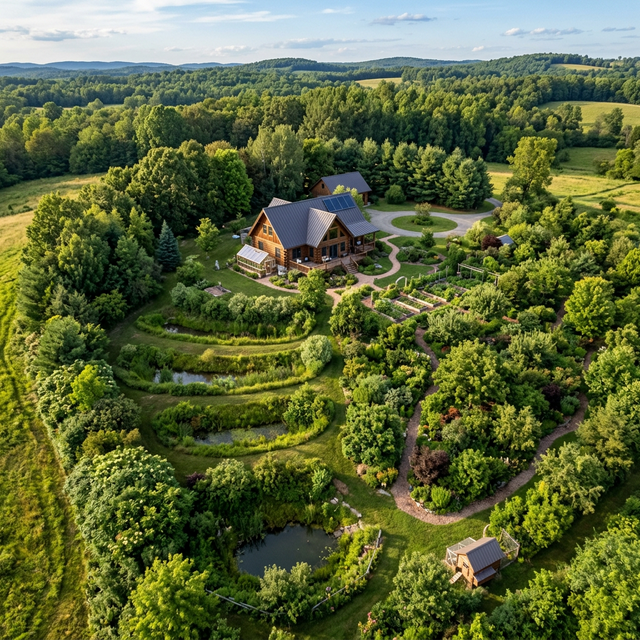
If you own 5 to 20 acres, you inhabit a unique middle ground. You have too much land to manage it like a suburban backyard garden, but not enough land to run a large-scale commercial cattle or row-crop operation.
This is the exact acreage where Permaculture shines brightest.
Permaculture (Permanent Agriculture) is not a specific gardening technique or a mystical philosophy. It is a highly practical design science based on observing how natural ecosystems function (like a mature forest) and mimicking those patterns to create productive, low-maintenance agricultural systems.
Instead of fighting nature by spraying weeds, mowing huge lawns, and hauling water uphill, permaculture asks: How can we design the property so the land does the work for us? Here is how to apply the core principles of permaculture to your small acreage.
1. The Zoning System (Designing by Frequency of Use)
The most famous—and most useful—permaculture concept is "Zoning." It organizes your property based on how often you need to visit a specific element. The goal is to save you thousands of miles of walking over a lifetime.
- Zone 0: The House. The center of human activity.
- Zone 1: Daily Access (The Kitchen Garden). This is the area immediately outside your back door. Put your daily-harvest herbs, salad greens, and the compost bin here. If you have to walk 100 yards through the rain to get basil for dinner, you won't do it.
- Zone 2: Intense Management (Orchards & Small Livestock). Accessed once or twice a day. This is the place for the chicken coop, the milking barn, the main vegetable crop garden, and the heavily pruned fruit orchard.
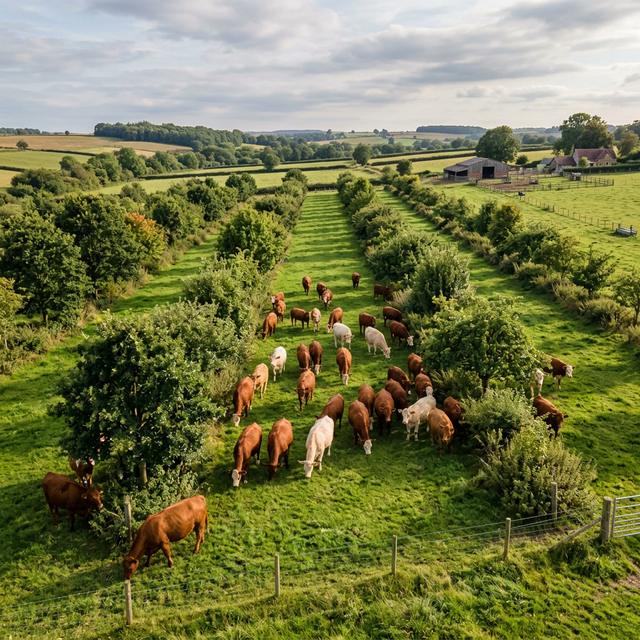
- Zone 3: Broadscale Agriculture (Pastures & Row Crops). Accessed weekly or seasonally. This is where you run your rotational grazing livestock (cows, sheep) and grow main-crop staples like corn or potatoes.
- Zone 4: Semi-Wild (Foraging & Timber). Accessed occasionally. This is managed woodland used for firewood collection, mushroom foraging, or seasonal hunting.
- Zone 5: The Wild. The unmanaged wilderness. You leave this area entirely alone. It acts as a sanctuary for native wildlife and a place for you to observe undisturbed natural patterns.
The Mistake to Avoid: Many new landowners put their chicken coop 200 yards away from the house because they are worried about the smell. But walking 400 yards round-trip through winter snow up to your knees, twice a day, to feed chickens will quickly make you hate homesteading. Bring Zone 1 and 2 elements close to the house.
2. Catch and Store Energy (Water First!)
In permaculture, "energy" means sunlight, wind, and water. On 5 to 20 acres, water is the energy you must master first.
Instead of letting rainwater rush off your property (taking topsoil with it), the goal is to make water walk.
- Swales on Contour: Dig shallow, level trenches horizontally across the slope of a hill. When it rains, water runs down the hill, hits the swale, stops moving, and slowly soaks deep into the soil.
- The Keyline Dam: Place your small pond as high up in the landscape as possible (the "keypoint"). This allows you to use gravity—not electric pumps—to irrigate the pastures, orchards, and gardens in Zones 2 and 3 below the pond.
3. Stacking Functions (Every Element Has Multiple Uses)
In a factory model of farming, an element only does one thing. A fence keeps cows in. A tree produces apples.
In permaculture, every element must earn its keep by performing three or more functions.
Example: The Chicken Tractor (Mobile Coop) Instead of a stationary coop that eventually turns into a muddy, smelly wasteland, put the chickens in a bottomless, mobile pen that you move every day across the pasture or garden.
- Function 1: It houses and protects the chickens.
- Function 2: The chickens eat the bugs (pest control).
- Function 3: Their manure fertilizes the grass or garden bed (fertilizer).
- Function 4: Their scratching acts as a light biological rototiller, preparing the seedbed.
Example: The Windbreak (Hedgerow) A row of trees planted on the north edge of your property.
- Function 1: Blocks harsh winter winds, lowering your home heating bill.
- Function 2: Provides dense, brushy habitat for wildlife.
- Function 3: If you plant hazelnut or elderberry, it produces food.
4. The Food Forest (Mimicking Nature's Layers)
A traditional orchard is a monoculture of apple trees planted in grid lines across mowed grass. It requires massive inputs of fertilizer, herbicide, and pesticides to survive because it is completely unnatural.
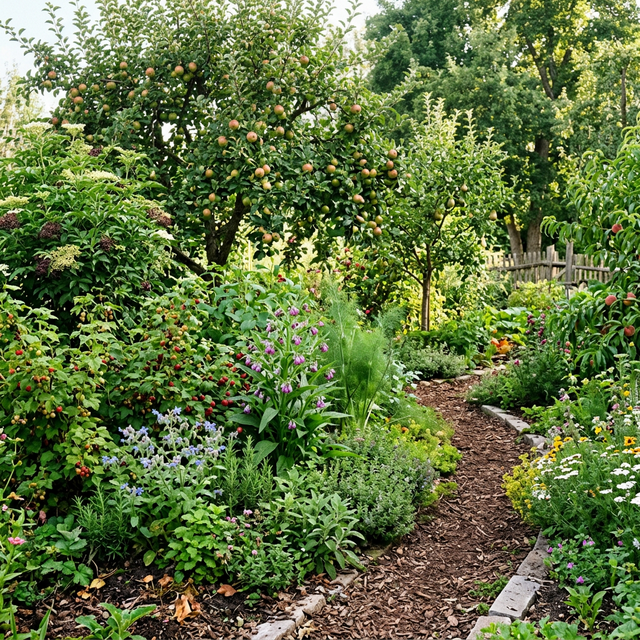
Nature doesn't grow in monocultures; it grows in forests. A "Food Forest" (or Forest Garden) mimics the architecture of a woodland ecosystem but uses edible plants. It utilizes 7 layers of vertical space:
- The Canopy: Large nut or timber trees (Chestnut, Pecan, Walnut).
- The Sub-Canopy: Smaller fruit trees (Apple, Plum, Pawpaw).
- The Shrub Layer: Berry bushes (Blueberry, Blackberry, Currants).
- The Herbaceous Layer: Non-woody perennials (Comfrey, Mint, Rhubarb).
- The Ground Cover: Creeping plants that act as living mulch (Strawberries, Clover).
- The Rhizosphere (Root Layer): Root crops (Garlic, Potatoes).
- The Vertical Layer: Climbing vines (Grapes, Kiwi, Hops) climbing up the canopy trees.
Because you have stacked nitrogen-fixing plants (clover) next to heavy feeders (apple trees), and pest-confusing aromatic herbs next to vulnerable berries, the system requires incredibly little maintenance once established.
5. Value the Margins (The Edges)
Ecology tells us that the place where two different environments meet—the "edge"—is the most biologically diverse and productive place in nature. An estuary (where river meets ocean) or a forest border (where woods meet grass) teems with life because species from both ecosystems overlap there.
Application: Maximize edges on your property.
- Don't build a perfectly square, straight-edged pond. Build a pond with a wavy, convoluted shoreline. This instantly doubles the amount of "edge space" available for wetland plants, frogs, and fish spawning.
- Instead of clearing your woods with a straight, hard line to your pasture, practice edge feathering to create a deeply scalloped, brushy transition zone.
Summary
Applying permaculture to a 5–20 acre property is about front-loading the design work so you don't have to break your back fighting nature for the next thirty years. By mapping your property into logical access zones, catching water high in the landscape, planting diverse multi-layered food forests, and insisting that every structure performs multiple functions, you engineer a homestead that is ecologically resilient, highly productive, and actually enjoyable to manage.
Explore more: Learn the foundational basics of managing this acreage in our guide to Starting a Small Homestead, or dive into independent infrastructure with Off-Grid Water and Energy Basics.
Sources & Further Reading
- The Permaculture Research Institute: permaculturenews.org
- Oregon State University — Permaculture Design Course Resources: open.oregonstate.edu
- Edible Forest Gardens by Dave Jacke and Eric Toensmeier: edibleforestgardens.com
- Regrarians (Regenerative Agriculture Design): regrarians.org
- The Center for Agroforestry at the University of Missouri: centerforagroforestry.org
Written by Tom Miller, Regenerative Agriculture & Homesteading Contributor at LandHelp.info. Tom holds a Permaculture Design Certificate (PDC) and designs intensive, low-maintenance food systems for small-acreage properties.
Tags:
Tom Miller
Regenerative Agriculture & Homesteading Contributor