Off-Grid Water and Energy Basics for Rural Properties
A beginner's guide to off-grid utilities for rural land. Learn the basics of solar power, rainwater catchment, and graywater systems for independence and resilience.
Off-Grid Water and Energy Basics for Rural Properties
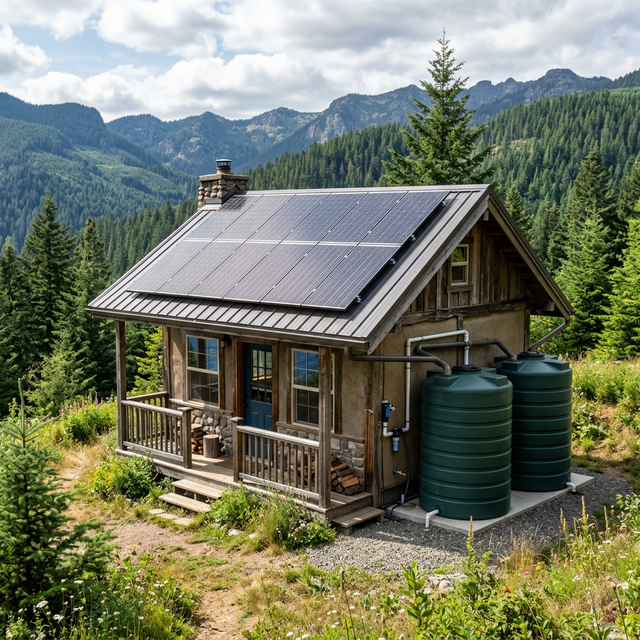
When an ice storm takes down the power lines, or a municipal main breaks, the vulnerabilities of modern rural living are exposed. For many landowners and homesteaders, establishing off-grid water and energy systems isn't just about environmental philosophy—it is about practical resilience, independence, and the financial reality that running grid power a half-mile down a dirt driveway can cost tens of thousands of dollars.
Transitioning to off-grid systems requires a radical shift in mindset: You must focus on extreme efficiency before you focus on generation. It is vastly cheaper to buy an ultra-efficient refrigerator than to buy the solar panels needed to run an old, inefficient one.
Here are the foundational basics of establishing independent water and energy systems on your rural property.
1. Off-Grid Energy: The Solar Foundation
While micro-hydro (if you have a fast-flowing, year-round creek with significant elevation drop) and wind power have their niches, Solar Photovoltaic (PV) is the undeniable king of off-grid energy for its reliability, plunging costs, and zero-maintenance profile.
The Four Components of an Off-Grid Solar System
An off-grid system requires more hardware than a suburban grid-tied roof.
- The Panels (Array): These capture sunlight and generate Direct Current (DC) electricity.
- The Charge Controller: This is the "brain." It regulates the voltage and current coming from the panels to safely charge the batteries without overcooking them.
- The Battery Bank: This stores the DC electricity for use at night or on cloudy days. Lithium Iron Phosphate (LiFePO4) batteries have become the industry standard due to their massive lifespan and safety compared to old lead-acid batteries.
- The Inverter: This converts the stored DC power from the batteries into the 120V Alternating Current (AC) power your standard household appliances plug into.
Sizing the System (The Energy Audit)
Before buying a single panel, you must conduct an energy audit. Write down every appliance you intend to use, its wattage, and how many hours a day it will run.
- A simple truth: You cannot heat with off-grid electricity cheaply. Do not plan on using electric baseboard heaters, an electric water heater, or an electric stove. Moving heat around requires massive wattage. Off-grid heating should rely on wood stoves or propane/natural gas.
2. Off-Grid Water: Supply and Storage
Water is the heaviest, hardest resource to move. Off-grid properties usually rely on two primary sources: a private well or rainwater catchment.
The Off-Grid Well
If you have a drilled well, the challenge is getting the water out of the ground without grid power.
- Solar Well Pumps: DC solar pumps are highly efficient. They connect directly to dedicated solar panels (no batteries required). When the sun shines, they pump water into a massive holding tank at the highest elevation on your property.
- Gravity-Fed Pressure: The water in that high-elevation tank then flows down to your house or barn. Every 2.3 feet of vertical drop creates 1 PSI (pound per square inch) of pressure. If your tank is 100 feet uphill from your cabin, you naturally have roughly 43 PSI at the faucet—no electric pressure pump required.
Rainwater Catchment (When You Can't Drill)
In areas where groundwater is too deep, too saline, or restricted, rainwater harvesting is the primary source.
- The Math: If you live in an area that gets 30 inches of rain a year, a 1,500-square-foot roof can capture over 25,000 gallons annually.
- The System: Gutters route rain through a "first-flush diverter" (which ejects the first few gallons of dirty water containing bird droppings and roof dust) into a large, dark cistern (to prevent algae growth).
- Purification: Before entering the house for drinking, the water is pumped through a series of sediment filters and finally a UV (ultraviolet) light system to kill any bacteria or viruses.
3. Managing the Waste: Septic and Graywater
Off-grid living means dealing with what happens after the water goes down the drain.
Traditional Septic
A standard septic system—a large underground tank where solids separate, followed by a perforated leach field where liquids filter through the soil—is highly effective and requires zero electricity. However, it requires specific soil types (it must "perc," or drain well) and significant acreage.
Graywater Systems (For Water Scarcity)
In arid regions, using perfectly good drinking water to flush a toilet and then sending it all to a septic tank is incredibly inefficient.
- Blackwater: Water from toilets. This must go to a septic system or a specialized composting toilet.
- Graywater: Water from showers, bathroom sinks, and washing machines. (Kitchen sink water is often excluded due to grease and food particles).
- The Hack: Graywater can be piped directly out to the landscape to irrigate fruit trees or ornamental gardens through subsurface perforated pipes. This drastically reduces the load on your septic system and waters your trees for free. (Check local county codes, as graywater laws vary significantly).
Composting Toilets
For small cabins or outbuildings where a $10,000 septic system isn't justifiable, modern composting toilets (like the Nature's Head or Sun-Mar) are entirely odor-free. They separate liquids from solids and use peat moss or sawdust to break human waste down into safe, usable compost over several months.
The Hybrid Approach: "Grid-Tied with Battery Backup"
For many rural landowners, fully disconnecting from a reliable municipal power grid doesn't make financial sense. However, they still want resilience against severe weather.
The modern compromise is a Grid-Tied Solar System with Battery Backup. You sell excess solar juice back to the utility company during the day, lowering your bill, but you maintain a small battery bank. When the grid goes down during a blizzard, an automatic transfer switch isolates your house, and your battery bank silently kicks in to keep your well pump, refrigerator, and internet running—without the noise and fuel requirements of a gas generator.
Summary
Ditching the utility companies provides ultimate freedom, but it transfers the responsibility of maintenance, conservation, and engineering directly onto your shoulders. Success requires treating energy and water like precious resources. Perform a rigorous energy audit, invest heavily in efficient appliances and insulation before buying solar panels, and utilize gravity to move water whenever possible.
Explore more: Learn how to integrate these off-grid systems into a broader land philosophy by exploring Permaculture Principles, or review how to manage water effectively in our Emergency Planning for Floods and Drought guide.
Sources & Further Reading
- Build It Solar (DIY Solar Projects and Guides): builditsolar.com
- American Rainwater Catchment Systems Association (ARCSA): arcsa.org
- Greywater Action — For a Sustainable Water Culture: greywateraction.org
- The Department of Energy — Off-Grid or Stand-Alone Renewable Energy Systems: energy.gov
- Mother Earth News — Off-Grid Living: motherearthnews.com
Written by Tom Miller, Regenerative Agriculture & Homesteading Contributor at LandHelp.info. Tom lives with his family on a 100% off-grid homestead, relying entirely on a 5kW solar array and a 5,000-gallon rainwater catchment system.
Tags:
Tom Miller
Regenerative Agriculture & Homesteading Contributor