Emergency Planning for Floods and Drought on Rural Land
A proactive emergency planning guide for rural landowners facing floods and droughts. Strategies for water management, livestock protection, and infrastructure resilience.
Emergency Planning for Floods and Drought on Rural Land
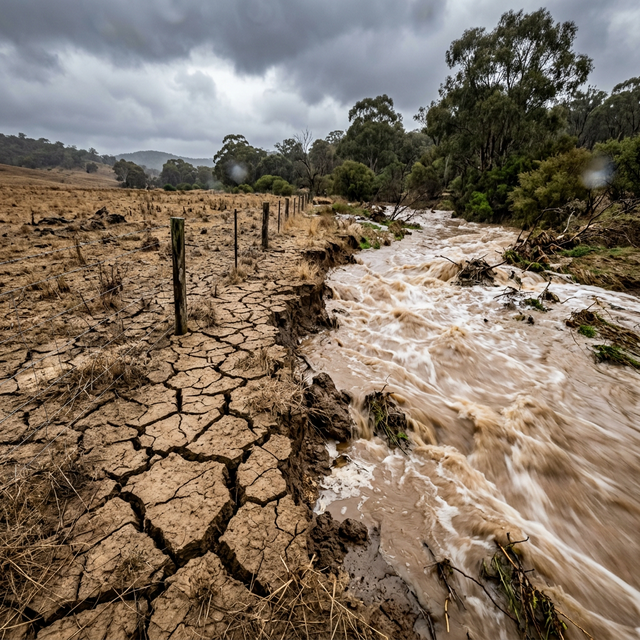
In rural land management, water is the ultimate double-edged sword: you usually have too much of it exactly when you don't need it, and you never have enough when you do.
As extreme weather events become more frequent, "waiting to see what the weather does" is no longer a viable management strategy. The financial survival of a small farm, or the ecological survival of a managed timber stand, depends heavily on how well the land has been physically prepped to handle the extremes of flood and drought.
Emergency planning for water extremes isn't about buying a generator or storing bottled water; it's about engineering your land's hydrology so the soil itself becomes the shock absorber.
Here is a practical, proactive framework for rural landowners to build resilience into their property before the disaster strikes.
1. Drought Preparation: Shrinking the Sponge
Drought is a slow-moving disaster. The secret to surviving a summer with no rain is capturing every single drop of rain that fell during the winter and holding it in the soil profile. We call this "increasing the soil sponge."
Building the Soil Sponge
If your soil has 1% organic matter, an acre can hold about 20,000 gallons of water. If you use regenerative practices to increase that to 4% organic matter, that same acre can hold 80,000 gallons of water. During a two-month drought, that extra 60,000 gallons is the difference between green grass and a dust bowl.
- Stop Tilling: Tillage destroys the fungal networks that bind soil particles together. Bare, powdered soil acts like pavement; when rain hits it, the water runs off instead of sinking in.
- Leave Residual Forage: Do not graze your pastures right down to the dirt. If you leave 4 to 6 inches of grass height, the roots below ground will drive 3 feet deep, accessing moisture long after the topsoil dries out.
- Plant Diverse Cover Crops: Introduce deep-rooted plants (like tillage radish or chicory) to physically break through hardpan soil, creating channels for heavy spring rains to infiltrate deeply into the subsoil aquifer.
Drought-Proofing Livestock Infrastructure
When creeks dry up and ponds turn to mud, animals die quickly.
- Develop secondary water sources: Do not rely on a single surface pond. Invest in a deep well with a solar pump, or pipe water from a reliable spring into buried frost-free tanks.
- De-stock early: The biggest mistake you can make during a drought is holding onto all your livestock, hoping it will rain tomorrow. You will destroy your pastures and go bankrupt buying $100 round bales of hay. Evaluate your forage in June; if it's below average, sell your bottom 20% of animals immediately while prices are still high.
2. Flood Preparation: Slow It, Spread It, Sink It
Flash flooding causes immediate, catastrophic damage: tearing out fences, drowning livestock, and washing away centuries of topsoil in a single afternoon. If you have a stream running through your property, you must manage the watershed above it.
The mantra of flood management is: Slow the water down, spread it out, and sink it in.
Managing the Upland Watershed
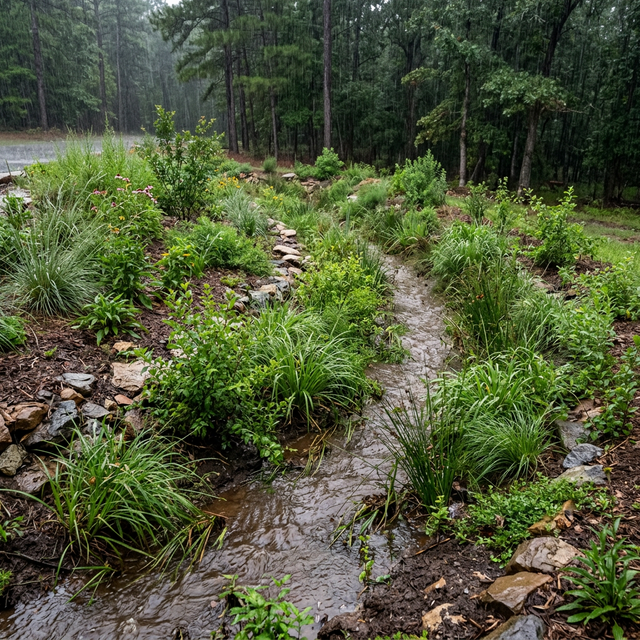
Instead of channeling water quickly off a hillside through straight ditches, you want to intercept it and slow its velocity.
- Swales on contour: Dig shallow, level trenches across the slope of hillsides. During a downpour, the rushing sheet water falls into the swale, stops immediately, spreads perfectly level along the hill, and slowly sinks into the groundwater.
- Keyline plowing: A specialized, minimum-disturbance subsoiler cuts deep, narrow slits along the hillside contour, fracturing compacted soil and completely halting downhill runoff.
Protecting the Stream Corridors
If your streams are bare-banked, a flood will act like a fire hose, undercutting the banks and widening the channel by several feet.
- Establish Riparian Buffers: The roots of native trees (like sycamores and willows) and deep-rooted native grasses (like switchgrass) act like rebar in the soil. They lock the stream banks together and resist the shear stress of floodwaters. Exclude livestock from the stream banks to allow this vegetation to establish.
- "Leaky" Check Dams: Do not build solid concrete dams in small creeks; they will blow out. Build small, low-profile piles of loose rock or logs (cross-vanes) that allow normal water to pass through, but slow down and pool the high-velocity floodwaters, forcing them to drop their destructive sediment load.
Emergency Livestock Evacuation
If your property is in a floodplain, you must have a "High Ground Plan."
- Identify the highest elevation paddock that has secure fencing and a backup water trough.
- When the National Weather Service issues a Flash Flood Watch (not a Warning—by then it's too late), immediately move all livestock into the high pasture.
- Never attempt to drive a tractor or truck to rescue animals once the water is flowing across field roads.
3. Financial and USDA Emergency Assistance
When natural disasters wipe out infrastructure or livestock, federal assistance is available, but you must be prepared before the event.
1. Establish Farm Records: You cannot get USDA disaster relief if the Farm Service Agency (FSA) does not know you exist. Register your property at your local FSA office and obtain a Farm and Tract Number immediately.
2. Document the "Before": Take geo-tagged photos of your fences, barns, ponds, and stream banks when they are in perfect condition. After a flood ruins them, these photos prove the extent of the damage to insurance adjusters and FEMA/USDA.
3. USDA Disaster Programs:
- LIP (Livestock Indemnity Program): Provides payments if your livestock drown in a flood or die from extreme heat/drought.
- LFP (Livestock Forage Disaster Program): Provides compensation if a severe drought (as defined by the U.S. Drought Monitor) destroys your normal grazing forage.
- ECP (Emergency Conservation Program): Provides funding to repair fences, remove debris, and restore conservation structures destroyed by natural disasters.
Summary
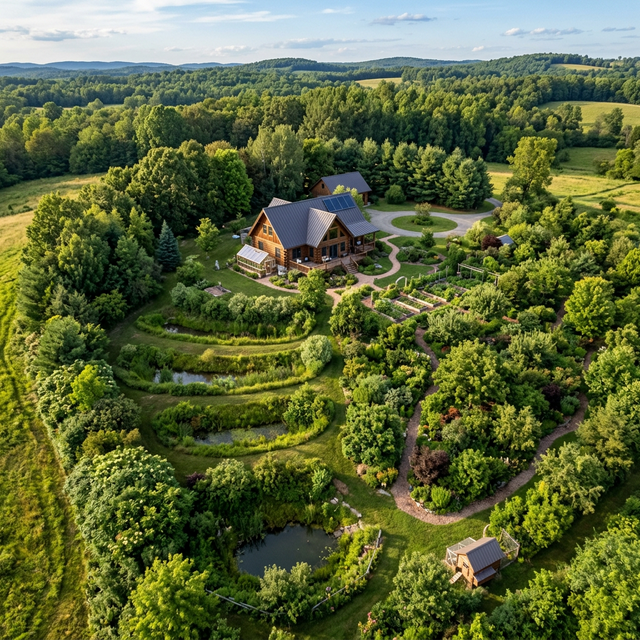
Climate resiliency on rural land is built entirely on the health of your soil and the diversity of your vegetation. A property with deep, un-compacted soil, diverse perennial pastures, and heavily vegetated riparian zones will shrug off a 4-inch downpour and stay green through a 6-week drought. Prepare your "Soil Sponge" now, build redundant water systems, and establish a relationship with your local FSA office before the disaster arrives.
Explore more: Dive deeper into water management by reading our guide to Building and Maintaining a Small Pond, or learn how to stabilize Stream Banks and Wetlands.
Sources & Further Reading
- Understanding Ag — The Soil Sponge: understandingag.com
- USDA Farm Service Agency — Disaster Assistance Discovery Tool: fsa.usda.gov
- National Weather Service — Flood Safety: weather.gov
- Penn State Extension — Flood Preparation and Recovery for Farms: extension.psu.edu
- The National Drought Mitigation Center: drought.unl.edu
- Permaculture Research Institute — Swale Design: permaculturenews.org
Written by Prof. James Chen, Contributing Expert – Water Resources at LandHelp.info. Professor Chen is a hydrologist who works with agricultural communities to design drought-resilient water systems and flood mitigation infrastructure.
Tags:

Prof. James Chen
Contributing Expert - Water Resources
Professor Chen is a leading expert in watershed management and water conservation. With 25 years in academic research and extension, he has published extensively on sustainable water management practices for agricultural lands.