Adapting Your Land to Changing Rainfall Patterns – Practical Steps
Prepare your rural property for climate extremes. Practical steps for private landowners to adapt to changing rainfall patterns, mega-droughts, and intense flooding events.
Adapting Your Land to Changing Rainfall Patterns – Practical Steps
If you ask any landowner who has farmed or managed timber for the last twenty years, they will tell you the same thing: The rain doesn't fall like it used to.
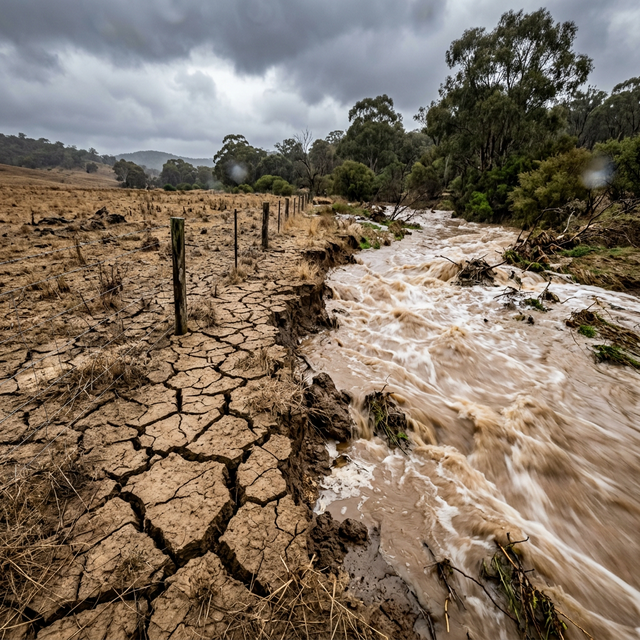
The slow, steady soaking rains of the past (often called "million-dollar rains") are increasingly rare. Instead, we are seeing a terrifying polarization of the water cycle: two months of absolute bone-dry drought, immediately followed by 6 inches of rain crashing down aggressively in a single 24-hour window. This whipsawing between extreme drought and extreme flooding is devastating to topsoil, infrastructure, and agricultural profitability.
You cannot control the sky, but you can control how your land physically reacts when the water hits the dirt. Here are the practical, on-the-ground steps landowners must take to adapt their properties to the new reality of changing rainfall patterns.
1. Redesigning the Ground to "Catch and Sink"
When 6 inches of rain falls in two hours, conventional drainage ditches and straight culverts become liability liabilities—they simply accelerate the water's destructive power, turning it into a high-velocity firehose that rips out fences and scours topsoil.
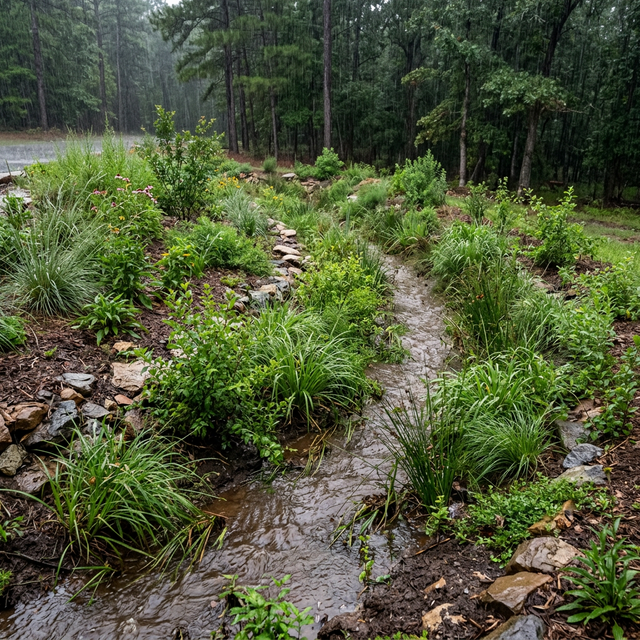
Your goal must shift from "getting the water off the land quickly" to "slowing the water down and forcing it into the ground."
Keyline Design and Swales
- Swales: Instead of vertical drainage ditches, build shallow, level trenches (swales) exactly on the horizontal contour of the hillside. When sheet water races downhill, it hits the level swale, stops dead, spreads evenly across the face of the hill, and slowly percolates down to recharge the groundwater aquifer.
- Keyline Subsoiling: Drag a specialized subsoiler plow (which barely disturbs the surface grass) along the contour of compacted pastures. This fractures the hardpan 12 inches down, creating underground veins that instantly absorb heavy rainfall rather than allowing it to run off to the creek.
2. Dramatically Increasing the "Soil Sponge"
You cannot build a pond big enough to hold all the water your land needs during a two-month drought. Your soil is the largest, cheapest reservoir you have.
The most critical statistic on your property is your soil organic matter (SOM) percentage. For every 1% increase in organic matter, an acre of soil can hold roughly 20,000 more gallons of water. If you increase your SOM from 1% to 4%, an acre holds an extra 60,000 gallons.
How to Build the Sponge
- Never Plow Bare Dirt: Tillage destroys the glomalin (the biological glue) that holds soil particles open. Powdered, tilled soil collapses and seals off during a heavy rain storm, creating 100% runoff. Adopt no-till or minimum-tillage practices exclusively.
- Leave Residual Grass Height: During a drought, the temperature of bare dirt can reach 140°F, evaporating every drop of surface moisture and cooking the soil biology. If you practice rotational grazing and leave 6 inches of grass standing after you move the cows, that grass acts as shade, dropping the soil temperature to 80°F and practically eliminating evaporation.
3. Decentralizing the Water Infrastructure
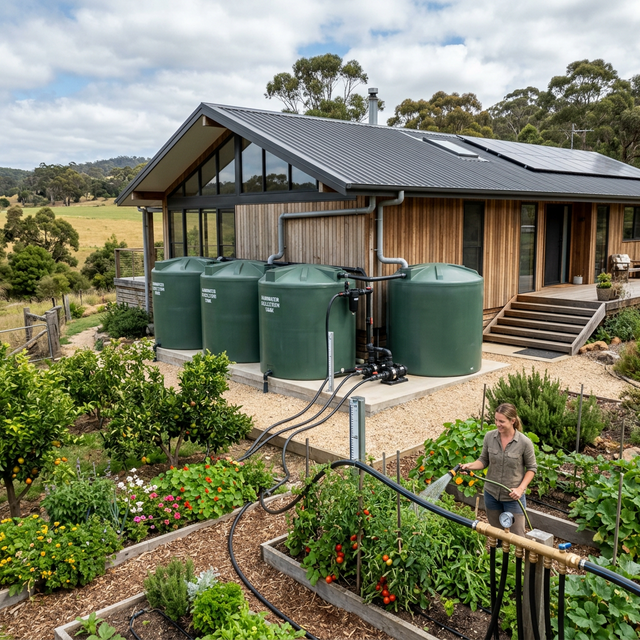
If your entire livestock or irrigation operation depends on a single deep well running on grid power, or a single creek at the bottom of a hill, you are highly vulnerable. Resilient land requires decentralized, redundant water points.
- Gravity Solar Wells: Install a DC solar pump on your well that pumps water whenever the sun shines into a massive high-elevation holding tank (e.g., a 2,500-gallon black poly tank). Use gravity to pipe this water to buried, frost-free troughs placed centrally in multiple pastures. Even if the well stops or the sun doesn't shine for a week, you have a massive gravity-fed reserve.
- Spring Development: If you have a natural wet weather spring that seeps out of a hillside in the spring but dries up in the summer, dig it out, lay a perforated pipe surrounded by gravel, and cap it with clay to capture that subterranean flow before it evaporates, piping it cleanly to a stock tank.
4. Adapting the Plant Species
The timber and forage species that thrived on your property in 1990 may no longer be viable by 2035.
- Deep-Rooted Perennials: Stop relying on shallow-rooted annuals or cool-season grasses (like fescue/bluegrass) that go completely dormant and turn brown the minute the summer heat hits. Replace them with deep-rooted Native Warm Season Grasses (NWSG) like Big Bluestem, Switchgrass, or Eastern Gamagrass. Their roots dive 6 to 10 feet deep, accessing moisture throughout the hottest mega-droughts, providing massive tonnage of high-quality August forage.
- Drought-Tolerant Timber: If you are planning a massive tree planting, do your research. If you live in an area trending hotter and drier, shift your planting mix away from water-loving species (like sycamore or river birch) and heavily toward drought-resilient upland species (like post oak, shortleaf pine, or drought-adapted hickories).
Funding the Adaptation
Adapting entire landscapes to extreme weather is incredibly expensive. Fortunately, the USDA views climate resilience as its topmost priority.
Through the EQIP program, the NRCS offers substantial cost-share funding to private landowners specifically to build the infrastructure required to survive drought and floods. You can receive financial assistance to offset the cost of:
- Drilling an agricultural livestock well and installing solar pumps
- Planting deep-rooted Native Warm Season Grasses
- Building cross-fencing to implement rotational grazing
- Installing erosion control structures on failing stream banks
Summary
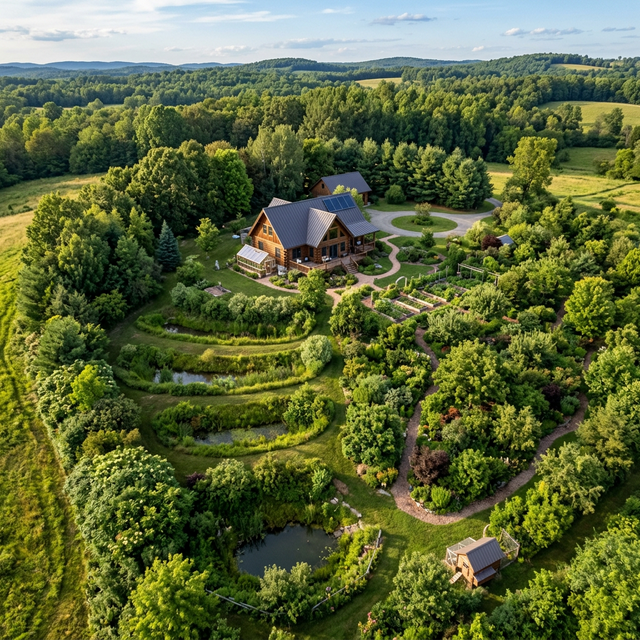
In an era of unpredictable and extreme rainfall patterns, defensive land management is the only path to profitability. Stop trying to drain the water off your property as fast as possible; use earthworks to slow it down, spread it out, and sink it into the aquifer. By aggressively building soil organic matter, shifting to deep-rooted native perennials, and decentralizing your water infrastructure, you engineer a property that acts as a massive sponge during floods and an unyielding reservoir during droughts.
Explore more: Dive into the immediate disaster response strategies outlined in our Emergency Planning for Floods and Drought guide, or learn more about building infrastructure with Off-Grid Water and Energy Basics.
Sources & Further Reading
- The Regrarians Handbook (Water Chapter): regrarians.org
- USDA Climate Hubs — Adaptation Resources for Agriculture: climatehubs.usda.gov
- National Drought Mitigation Center: drought.unl.edu
- Understanding Ag — Soil Water Holding Capacity: understandingag.com
- The Center for Watershed Protection: cwp.org
Written by Prof. James Chen, Contributing Expert – Water Resources at LandHelp.info. Professor Chen is a hydrologist who works extensively with agricultural communities to design drought-resilient water systems and flood mitigation infrastructure utilizing keyline design principles.
Tags:

Prof. James Chen
Contributing Expert - Water Resources
Professor Chen is a leading expert in watershed management and water conservation. With 25 years in academic research and extension, he has published extensively on sustainable water management practices for agricultural lands.