Regenerative Agriculture Practices for Small-Scale Landowners
A practical guide to regenerative agriculture for small-scale landowners. Learn the 5 principles of soil health and how to implement no-till, cover crops, and rotational grazing.
Regenerative Agriculture Practices for Small-Scale Landowners

For decades, modern agriculture focused on sustainability—the idea of maintaining the current state of a resource so it doesn't get worse. But if your soil is already compacted, depleted of organic matter, and eroding into the creek, "sustaining" that degraded state is the wrong goal.
You don't want to sustain a broken system; you want to regenerate it.
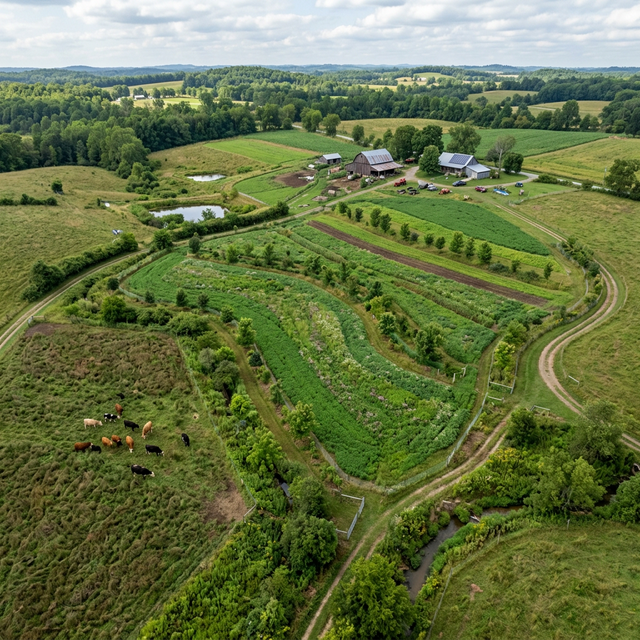
Regenerative Agriculture is a system of farming and land management that actively rebuilds soil health, restores biodiversity, and improves the water cycle. It is the cheapest, most effective way for small-scale landowners to drought-proof their property, eliminate expensive synthetic fertilizers, and significantly increase the carrying capacity of their land.
Here are the Five Principles of Soil Health, and exactly how to implement them on 10 to 50 acres.
The Core Philosophy: Feed the Microbiology
Regenerative agriculture requires a massive shift in mindset. You are no longer growing grass or vegetables; you are farming soil microbes.
A teaspoon of healthy soil contains more living organisms (bacteria, fungi, protozoa, and nematodes) than there are humans on Earth. These microbes form a symbiotic relationship with plant roots. The plant uses photosynthesis to create liquid carbon (sugars), which it pumps out of its roots to feed the microbes. In exchange, the microbes digest the sand, silt, and clay, mining minerals and delivering them back to the plant.
When you spray synthetic fertilizer or plow the ground, you kill the workforce, break this symbiotic loop, and force your plants onto life support.
Principle 1: Limit Mechanical and Chemical Disturbance (Stop Plowing)
The Problem: Tillage acts like a tornado tearing through a city. Every time you run a rototiller through a garden or a disc across a pasture, you shred the delicate, microscopic fungal networks (mycorrhizal fungi) that connect plant roots and distribute nutrients. Furthermore, exposing bare soil to the sun oxidizes the carbon, sending it into the atmosphere. The Fix:
- In the garden: Adopt the "no-till deep mulch" method. Smother weeds with cardboard and pile compost and straw 6 inches deep over the beds. Plant directly into the compost.
- In the pasture: Instead of plowing up a weak pasture to reseed it, use a rented "no-till drill" from your local soil conservation district to slice a tiny ÂĽ-inch slit in the sod and drop the seed perfectly into place without disturbing the surrounding soil structure.
Principle 2: Armor the Soil Surface (Keep It Covered)
The Problem: Bare dirt is an unnatural emergency. Like an open wound, the earth will immediately try to scab it over with whatever seeds are available (we call these "weeds"). Bare soil bakes in the 100-degree summer sun, cooking the microbes just beneath the surface, and immediately washes away during a heavy rain. The Fix:
- Keep the soil armored 365 days a year with living plants or a thick layer of decomposing plant residue (mulch, hay, or rolled-down cover crops).
- If you use a prescribed burn, time it right before a targeted rain event so the ground greens up immediately, rather than leaving it black and bare for months.
Principle 3: Build Diversity (Nature Abhors a Monoculture)
The Problem: Planting a massive field of only tall fescue, or a massive garden of only tomatoes, invites disease. Different plants pump different types of carbon (root exudates) into the soil. A monoculture only feeds one specific type of soil microbe, creating a weak, imbalanced ecosystem. The Fix:
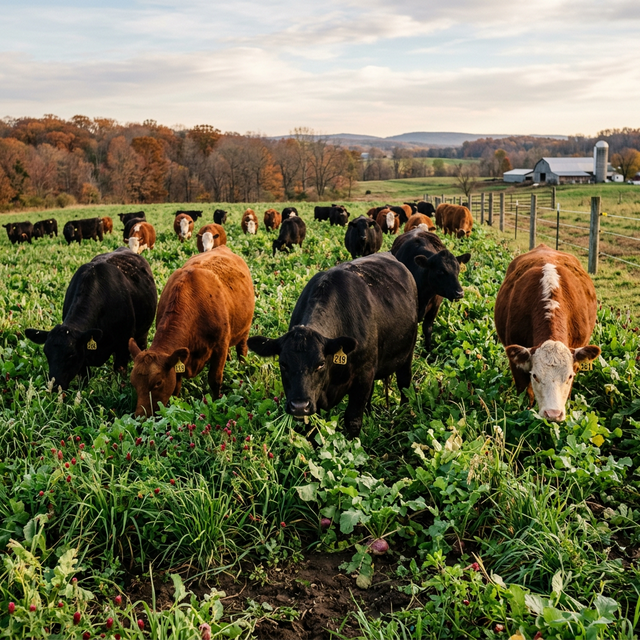
- Multi-species cover crops: Rather than just planting winter wheat, plant a mix of 10 different species: oats, tillage radish, vetch, crimson clover, and buckwheat.
- Diverse pastures: A healthy pasture should have dozens of broadleaf forbs (like plantain and chicory) and legumes mixed in with the grass. These deep-rooted plants pull entirely different minerals from deep in the subsoil. Look at pollinator habitats as a model for diversity.
Principle 4: Keep Living Roots in the Soil Year-Round
The Problem: Most conventional crop fields lie completely bare from the November harvest until the May planting. During those 6 months, no liquid carbon is being pumped into the soil by living roots, so the soil microbiology starves to death. The Fix:
- The moment your summer garden crops or sweet corn is harvested, immediately throw down a winter cover crop seed (like cereal rye). The roots stay alive all winter, continuing to feed the microbes, capturing free nitrogen from the air, and preventing spring erosion.
Principle 5: Integrate Livestock (The Missing Link)
The Problem: Before modern farming, massive herds of herbivores (like bison) roamed the land. They grazed intensely for a few hours, trampled the remaining grass onto the soil surface, left nutrient-dense manure and urine behind, and didn't return to that spot for six months. Without animal impact, ecosystems stagnate. The Fix:
- You cannot achieve true regenerative agriculture without animals. You must mimic the bison.
- Practice Adaptive Multi-Paddock (AMP) grazing—often called high-density rotational grazing. Run your cattle, sheep, or chickens in small paddocks using movable electric fence. Move them every 12 to 24 hours. The intense grazing followed by long rest periods forces the grass to push roots deeper and inject massive amounts of carbon into the soil.
The Financial Reality of Regeneration
Transitioning to regenerative practices is not an overnight process; it often takes 3 to 5 years for the soil biology to wake up and take over the heavy lifting. However, the financial economics of small-scale agriculture change drastically when you:
- Stop paying for fertilizer (because your clover is fixing free nitrogen).
- Stop paying for herbicide (because your multi-species cover crops outcompete the weeds).
- Stop paying for diesel (because you aren't dragging a plow across the field six times a year).
- Stop paying for winter hay (because your grass stays green later into the fall).
Better yet, the USDA NRCS heavily subsidizes the transition. Through the EQIP program, the USDA will literally pay you per acre to plant cover crops, implement rotational grazing, and stop tilling your fields.
Summary
Regenerative agriculture is the paradigm shift required to make small acreage profitable and ecologically sound. By abandoning the plow, maintaining soil armor, maximizing plant diversity, keeping living roots in the ground, and intensively managing livestock, you restore the biological function of the soil. When your soil functions correctly, you achieve drought resilience, massive cost savings, and the satisfaction of leaving the land vastly better than you found it.
Explore more: Learn the foundational mechanics of animal impact in our Rotational Grazing for Beginners guide, or read how building soil organic matter helps your property Survive Floods and Drought.
Sources & Further Reading
- Understanding Ag — The 6 Principles of Soil Health: understandingag.com
- USDA NRCS — Soil Health Principles: nrcs.usda.gov
- Kiss the Ground (Non-Profit & Documentary on Regenerative Ag): kisstheground.com
- Sustainable Agriculture Research and Education (SARE) — Building Soils for Better Crops: sare.org
- The Savory Institute — Holistic Planned Grazing: savory.global
Written by Tom Miller, Regenerative Agriculture & Homesteading Contributor at LandHelp.info. Tom manages a highly diverse, no-till homestead and frequently consults with landowners transitioning from conventional farming to regenerative practices.
Tags:
Tom Miller
Regenerative Agriculture & Homesteading Contributor