Thinning Your Woods: When, Why, and How to Do It Safely
Learn when and how to thin your woodland for better timber quality, wildlife habitat, and forest health. A practical guide for private landowners with step-by-step advice.
Thinning Your Woods: When, Why, and How to Do It Safely

Most private woodlands in the United States are significantly over-stocked. Decades of fire suppression and neglect have produced forests so dense that individual trees compete fiercely for light, water, and nutrients — growing slowly, staying small-diameter, and remaining vulnerable to drought, disease, and storm damage.
Thinning changes all of that. By strategically removing the weakest trees, you concentrate growth on the best individuals, improve wildlife habitat, reduce wildfire risk, and often generate timber income in the process.
But done wrong — cutting the wrong trees, hiring the wrong logger, or thinning at the wrong time — thinning can damage a forest for decades. This guide gives you the knowledge to do it right.
Why Thin Your Woods?
Thinning serves multiple purposes simultaneously:
1. Improved Timber Quality
Dense stands produce slow-growing trees with small diameters and more defects. After thinning, residual trees:
- Add 2–4x more diameter growth per year
- Develop better crown form and cleaner boles
- Reach merchantable size years faster
- Command higher prices at harvest
2. Better Wildlife Habitat
A closed-canopy forest has limited wildlife value. Thinning creates:
- Understory vegetation — grasses, forbs, and shrubs that provide food and nesting cover
- Diverse age structure — different habitat zones for different species
- Mast production — oaks, hickories, and other mast trees produce far more acorns when crowns have space to expand
- Openings for deer, turkey, and early-successional species like woodcock and bobwhite quail
3. Reduced Wildfire Risk
In fire-prone regions, over-stocked forests create dangerous "ladder fuels" that allow ground fires to climb into the crown. Thinning combined with prescribed burning (in appropriate regions) dramatically reduces wildfire intensity and spread.
4. Improved Forest Health
Stressed trees in overcrowded stands are more vulnerable to:
- Bark beetle outbreaks
- Root rot fungal infections
- Drought mortality
- Storm damage (ice, wind)
Thinning reduces competition stress, increasing individual tree resistance to pests and disease.
When to Thin
Timing depends on several factors:
Forest Age and Condition
| Forest Stage | Recommended Action |
|---|---|
| Young stand (10–25 years) | Pre-commercial thinning — no sawlogs yet; remove competing stems to favor best trees |
| Pole timber (25–50 years) | Commercial thinning — removed trees may have some log value |
| Sawtimber (50+ years) | Selection harvest/thinning — removed trees have significant commercial value |
Signs Your Woods Need Thinning
- Canopy is closed — you can't see 30+ feet between trees without obstacles
- Live crown ratio (proportion of tree height with live branches) is less than 30% on most trees
- Significant dead and dying trees from competition
- Little to no understory vegetation
- Trees lean against each other (inter-locked crowns)
Seasonal Timing
For most regions, the best time to conduct thinning operations is:
- Late fall through early spring — frozen or dry ground minimizes soil compaction from equipment
- Avoid late spring through summer in bark-beetle prone areas (fresh wounds attract beetles)
- Avoid logging during bird nesting season (April–July) if you're managing for songbird habitat
How to Thin Your Woods: Step by Step
Step 1: Walk Your Woods with a Forester
Before doing anything, hire a Consulting Registered Forester (CRF) for an on-the-ground assessment. Consulting foresters (as opposed to loggers' foresters) work for you, not the timber buyer. They can:
- Inventory your timber and assess stand conditions
- Design a thinning prescription based on your goals
- Write a timber sale contract that protects your interests
- Monitor the logging operation for compliance
Many state forestry agencies also provide free or low-cost forest management assistance to private landowners. Find your state contact at stateforesters.org.
Step 2: Define Your Goals
Your thinning prescription will differ depending on whether your priority is:
- Timber production: Focus on crop tree release — remove competitors around your best, straightest trees
- Wildlife habitat: Retain mast-producing species (oaks, hickories), create openings, leave snags (dead trees)
- Wildfire risk reduction: Prioritize ladder fuel removal, focus on understory thinning
- A mix of all three: This is usually achievable — communicate your priorities clearly to your forester
Step 3: Mark Trees to Remove
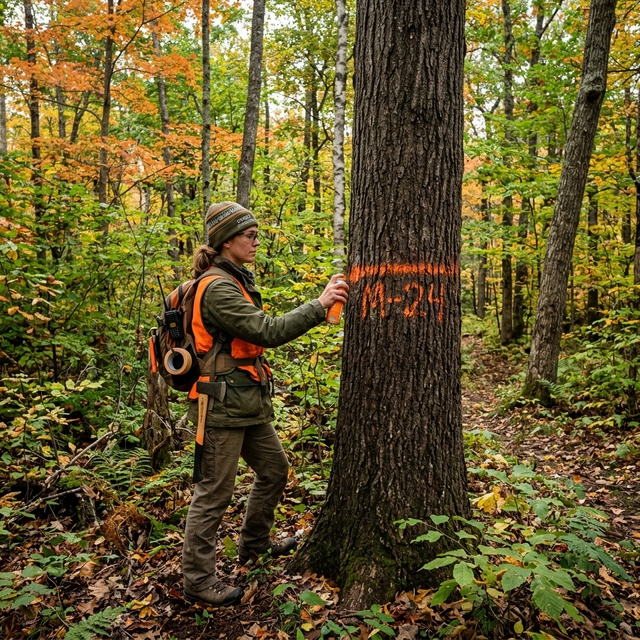
The cardinal rule of thinning: mark trees to remove, not trees to keep. If you only mark crop trees (trees to keep), loggers will take whatever suits them.
Common marking guidelines:
- Remove dead, dying, and diseased trees first
- Remove trees with severe lean, forked tops, or significant defects
- Thin to a target basal area — typically 60–80 square feet per acre for hardwoods after thinning (your forester will calculate this)
- Leave wildlife trees: snags (standing dead trees), trees with cavities, and large-diameter veterans
Step 4: Sell the Timber or Conduct TSI
Depending on the size of trees removed, you may:
Commercial thinning: Removed trees are large enough to sell. Get bids from at least 3 qualified loggers — prices vary significantly. A consulting forester can run a competitive bid process.
Pre-commercial thinning (Timber Stand Improvement / TSI): Removed trees have no commercial value; you cut them yourself with a chainsaw or hire a TSI crew. USDA NRCS EQIP funds TSI work at 50–75% cost-share under the Forest Stand Improvement practice.
Step 5: Protect the Residual Stand During Operations
Even a well-designed thinning can cause significant "collateral damage" if the logging operation is poorly managed:
- Require skid trails to be marked on your map before work begins
- Require loggers to minimize residual tree wounding (damaged trunk bases allow decay entry)
- Inspect during and after the operation — don't pay final settlement until you're satisfied
- Ensure required brush piles, slash disposal, and site restoration are completed
What to Leave: Creating Structural Diversity
A thinned forest is an opportunity to build in structural diversity for wildlife and long-term resilience:
- Snags: Leave 2–5 large standing dead trees per acre — essential for cavity-nesting birds and mammals
- Coarse woody debris: Leave some downed logs for salamanders, small mammals, and invertebrates
- Mast trees: Never cut a healthy oak, hickory, or other mast-producing tree unless it's severely damaged
- Vine tangles: Dense grape vine or greenbrier patches provide excellent cover — leave small patches
USDA Programs for Thinning and Forest Improvement
| Program | What It Covers | Cost-Share Rate |
|---|---|---|
| EQIP — Forest Stand Improvement | TSI, prescribed burns, invasive control | 50–75% |
| EQIP — Forest Trails | Trails for management access | 50–75% |
| CSP — Forest Practice Enhancement | Enhancements for certified forest plans | Annual payments |
| FLEP (Forest Legacy Program) | Cost-share for management plan development | Varies by state |
Common Mistakes to Avoid
- High-grading: Removing only the best trees and leaving the worst — this is how unethical loggers maximize short-term profit while damaging the stand for generations. Always use a consulting forester.
- Over-thinning: Taking too much basal area at once creates wind throw risk and excessive competition from ground vegetation
- Thinning during drought: Freshly thinned trees under drought stress are highly vulnerable to bark beetles
- Forgetting the contract: Never allow a logger on your property without a written timber sale agreement
Summary
Thinning is one of the most powerful woodland management tools available to private landowners — dramatically improving timber quality, wildlife habitat, and forest health simultaneously. The key to success is working with a qualified consulting forester, having a clear prescription based on your goals, and managing the logging operation carefully.
Explore more: Browse our Forests & Woodlands resources or learn about agroforestry on small acreage.
Sources & Further Reading
- US Forest Service — Silviculture Practices: fs.usda.gov
- Society of American Foresters — Find a Consulting Forester: eforester.org
- National Association of State Foresters: stateforesters.org
- University of Minnesota Extension — Forest Stand Improvement: extension.umn.edu
- USDA NRCS — Forest Stand Improvement Practice (666): nrcs.usda.gov
- Virginia Department of Forestry — Timber Harvest Guide: dof.virginia.gov
- Penn State Extension — Timber Sales and Contracts: extension.psu.edu
Written by Dr. Sarah Mitchell, Senior Editor & Land Management Specialist at LandHelp.info. Dr. Mitchell holds a Ph.D. in Natural Resource Management from Colorado State University and is a Certified Forester with over 20 years of experience in private land forestry.
Tags:
Dr. Sarah Mitchell
Senior Editor & Land Management Specialist
Dr. Mitchell has over 20 years of experience in natural resource management, with expertise in sustainable agriculture and forest stewardship. She holds a Ph.D. in Natural Resource Management from Colorado State University and has worked with the USDA NRCS for 15 years.
You Might Also Like
Related Resources
External tools, guides, and references related to this topic
Silviculture Guide to Species
Detailed silvicultural guides for major North American tree species. Covers regeneration, growth, and management of various forest types.
Forest Carbon Credits 101
Comprehensive guide to forest carbon credit programs. Learn how to enroll your forest land, measure carbon sequestration, and sell carbon credits.
Agroforestry Practices
Technical guides for implementing agroforestry systems including alley cropping, silvopasture, windbreaks, and forest farming.
Tree Planting Calculator
Calculate spacing, number of trees needed, and costs for reforestation projects. Includes species-specific recommendations.