Agroforestry on Small Acreage – Combining Trees with Crops or Livestock
Learn how to implement agroforestry systems on 5–50 acre properties. Discover silvopasture, alley cropping, and forest farming approaches that generate income while improving land health.
Agroforestry on Small Acreage – Combining Trees with Crops or Livestock
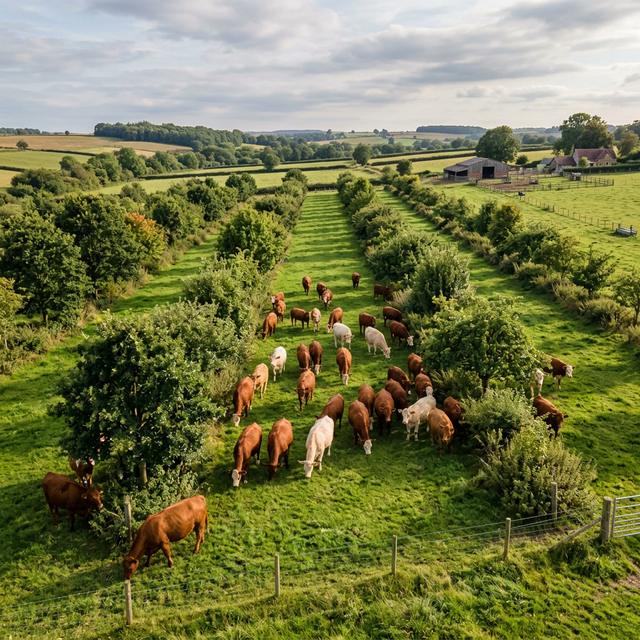
For generations, the conventional wisdom in American agriculture was clear: crops go in fields, livestock go in pastures, trees go in forests — and never the twain shall meet. Modern land management science has turned that thinking on its head.
Agroforestry — intentionally integrating trees with crops or livestock — consistently outperforms monoculture systems in profitability, resilience, and ecological benefit on small to medium acreages. It's the original multi-use land management strategy, refined with modern science.
Whether you have 5 acres or 500, this guide introduces you to the four main agroforestry practices that work on small private land, with real-world examples and resources for getting started.
Why Agroforestry Works
Trees provide services that row crops and pastures alone cannot:
- Root depth: Tree roots access water and nutrients 10–30 feet deep, far below annual crop roots
- Microclimate regulation: Tree canopies reduce temperature extremes and wind speeds, improving livestock comfort and crop productivity
- Diverse income streams: Timber, nut/fruit crops, livestock, carbon credits, and ecosystem service payments — all from the same acre
- Soil health: Leaf litter, deep roots, and reduced tillage build organic matter and reduce erosion dramatically
- Resilience: Multiple products mean diversified risk — if hay prices crash, timber or nut income buffers the loss
According to USDA National Agroforestry Center research, well-designed agroforestry systems generate 2–3x higher net returns per acre than equivalent conventional monoculture systems over 20+ years.
The Four Main Agroforestry Practices
1. Silvopasture — Trees + Livestock in the Same Space
What it is: Intentionally integrating trees into pastures where livestock graze, or grazing animals under existing woodlands.
How it works:
- Trees are planted in rows, clusters, or scattered patterns across pastures
- Livestock graze between and beneath trees
- Trees provide shade (reduces heat stress — a major production limiter), wind protection, and supplemental food (nuts, browse)
- Livestock soil disturbance and manure improve tree growth in the zone around each tree
Economic case:
- Shade can increase livestock weight gains by 8–25% in hot climates
- Nut-producing trees (pecan, walnut, chestnut) add a second income stream after 8–15 years
- Silvopasture systems qualify for carbon credits through programs like Indigo Carbon and Verra VCS
Getting started:
- Plant 3–10 trees per acre in widely spaced rows (40–60 feet apart) to allow equipment access and maintain grass production
- Choose species that benefit livestock: chestnut and pecan for mast, Eastern redcedar or black locust for wind breaks, native oaks for long-term timber
- Use electric fence to exclude livestock until trees are established (4–5 years minimum)
Best suited for: Cattle, sheep, goat, and poultry producers on 10+ acre properties
2. Alley Cropping — Trees + Annual Crops in Alternating Rows
What it is: Annual or perennial crops are grown in the alleys (lanes) between widely spaced rows of trees.
How it works:
- Tree rows are spaced 30–100 feet apart (depending on species and equipment)
- Annual crops (corn, soybeans, vegetables, small grains) are grown in the alleys
- Tree crops (timber, nuts, fruits) generate income as trees mature
- Annual crop productivity is maintained for 10–20 years until the tree canopy closes
Economic case:
- Maintains annual crop income during the early years when trees aren't yet productive
- Creates multiple marketable products — timber, nuts, and crops — on the same acres
- Windbreak effect from tree rows can increase adjacent crop yields by 5–25%
Best for: Properties transitioning from conventional row crops to more diverse systems; farmers who want to add trees without losing immediate crop income
Example system: Pecans or black walnuts spaced 60 feet apart, with native wildflower strips or vegetable production in the alleys — works well on 5–50 acre properties.
3. Windbreaks and Shelterbelts — Trees for Farm Protection
What it is: Linear plantings of trees and shrubs on the borders of fields, pastures, or homesteads to reduce wind speed and its associated damage.
Functions:
- Wind speed reduction: A well-designed shelterbelt reduces wind speeds by 50–75% for a distance of 10–15x the tree height on the leeward side
- Livestock protection: Reduces cold stress and mortality during winter storms
- Crop yield improvement: Reduced evapotranspiration in the wind shadow zone increases crop yields
- Wildlife corridor: Linear tree plantings connect habitat patches for birds and mammals
- Snow management: Can be designed to capture snow for moisture, or deflect it away from roads and buildings
Design basics:
- Multi-row shelterbelts (5–9 rows) work better than single rows
- Combine tall trees (cottonwood, spruce), medium trees (hackberry, chokecherry), and shrubs (wild plum, currant)
- Plant perpendicular to the prevailing wind
USDA NRCS funds windbreak establishment under the EQIP Windbreak or Shelterbelt Establishment practice (Practice 380).
4. Forest Farming — Growing Specialty Crops Under Forest Canopy
What it is: Cultivating high-value non-timber forest products (NTFPs) beneath a managed forest canopy.
High-value crops for forest farming:
| Crop | Growing Conditions | Market Price | Time to Production |
|---|---|---|---|
| Shiitake mushrooms | Shaded hardwood logs | $10–$20/lb | 6–18 months |
| Ramps (wild leeks) | Rich, moist hardwood forest | $10–$30/lb | 5–7 years |
| American ginseng | North-facing forested slopes | $300–$1,000/lb dry | 5–10 years |
| Pawpaw fruit | Humid Eastern woodlands | $5–$15/lb | 5–8 years |
| Elderberry | Forest edges, partial shade | $5–$10/lb | 2–3 years |
Forest farming advantages for small acreage:
- Very high income potential per acre (ginseng can generate $10,000+ per acre)
- Low capital investment — uses existing forest infrastructure
- Compatible with ongoing timber management
- Growing demand for locally grown specialty forest products
Getting Started: A Step-by-Step Approach
- Assess your land: What existing tree cover, soil types, and water availability do you have?
- Define your goals: Timber income? Livestock integration? Specialty crops? A combination?
- Connect with resources:
- USDA National Agroforestry Center (NAC): fs.usda.gov/nac
- Your local NRCS office for technical assistance and EQIP cost-share
- State university extension — many offer free agroforestry consultations
- Start small: Pilot a 1–2 acre system before scaling up
- Document everything: Track costs, production, and income from the start for tax purposes and future grant applications
Conservation Programs for Agroforestry
USDA NRCS actively supports agroforestry through multiple programs:
| Program | Agroforestry Practices Supported |
|---|---|
| EQIP | Tree planting, windbreaks, alley cropping, silvopasture |
| CSP | Existing agroforestry system enhancements |
| RCPP | Regional partnerships with agroforestry focus |
| FSA CRP | SAFE (Signup for Air, Forest, and Ecology) practices |
Summary
Agroforestry isn't a nostalgic return to the past — it's a sophisticated, evidence-based land use system that outperforms conventional monocultures on profitability, resilience, and ecological health. On small acreages of 5–50 acres, silvopasture, alley cropping, and forest farming offer the highest-return land integration strategies available.
Start with a free consultation at your local NRCS office, then explore the USDA National Agroforestry Center for design resources and species recommendations.
Explore more: Browse our Forests & Woodlands resources or learn about native trees to plant for timber and wildlife.
Sources & Further Reading
- USDA National Agroforestry Center: fs.usda.gov/nac
- USDA NRCS — Agroforestry Practices Overview: usda.gov/topics/forestry/agroforestry
- Association for Temperate Agroforestry (AFTA): aftaweb.org
- Penn State Extension — Forest Farming: extension.psu.edu/forest-farming
- University of Missouri Center for Agroforestry: centerforagroforestry.org
- Savanna Institute — Silvopasture Resources: savannainstitute.org
- USDA NRCS — EQIP Agroforestry Practices: nrcs.usda.gov
Written by Dr. Sarah Mitchell, Senior Editor & Land Management Specialist at LandHelp.info. Dr. Mitchell holds a Ph.D. in Natural Resource Management from Colorado State University and is a Holistic Management Certified Educator with over 20 years of experience in agroforestry system design.
Tags:

Dr. Sarah Mitchell
Senior Editor & Land Management Specialist
Dr. Mitchell has over 20 years of experience in natural resource management, with expertise in sustainable agriculture and forest stewardship. She holds a Ph.D. in Natural Resource Management from Colorado State University and has worked with the USDA NRCS for 15 years.
You Might Also Like
Related Resources
External tools, guides, and references related to this topic
Silviculture Guide to Species
Detailed silvicultural guides for major North American tree species. Covers regeneration, growth, and management of various forest types.
Forest Carbon Credits 101
Comprehensive guide to forest carbon credit programs. Learn how to enroll your forest land, measure carbon sequestration, and sell carbon credits.
Agroforestry Practices
Technical guides for implementing agroforestry systems including alley cropping, silvopasture, windbreaks, and forest farming.
Tree Planting Calculator
Calculate spacing, number of trees needed, and costs for reforestation projects. Includes species-specific recommendations.