Spotted Lanternfly: Latest Quarantine Maps and 2026 Homeowner Action Steps
The 2026 update on the Spotted Lanternfly expansion. Learn how to identify egg masses, utilize circle traps, and protect your vineyard or orchard from this devastating pest.
Spotted Lanternfly: Latest Quarantine Maps and 2026 Homeowner Action Steps
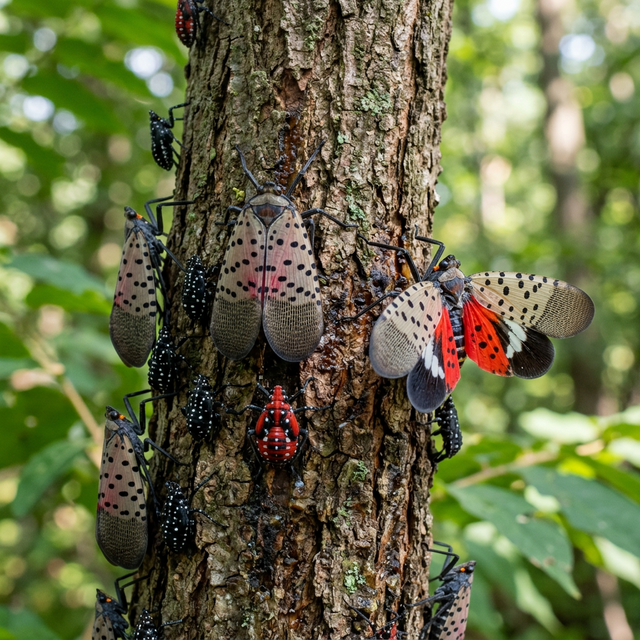
When the Spotted Lanternfly (SLF) first arrived in Pennsylvania a decade ago, agricultural officials sounded the alarm. By 2026, those alarms have proven entirely justified. This invasive planthopper from Asia has rapidly expanded its territory across the Northeast, Midwest, and deep into the Mid-Atlantic, devastating commercial vineyards and wreaking havoc on private hardwood forests, orchards, and backyard maple trees.
The Spotted Lanternfly doesn't bite humans or eat leaves. Instead, it acts like a giant, swarming aphid. It inserts a piercing mouthpart into the trunk or stems of a plant, sucking out the vital phloem sap. As it feeds, it excretes immense amounts of sugary liquid called "honeydew," which quickly coats everything below the tree in a thick, black, sooty mold that blocks photosynthesis and attracts swarms of stinging wasps.
Why do landowners need a specific action plan in 2026? Because the pest has moved beyond the "eradication" phase in many states; we are now firmly in the "management and mitigation" phase. If you own fruit trees, timber, or just enjoy sitting on your patio without being rained on by sap, here is exactly what you must do this year to defend your property.
1. Understanding the 2026 Quarantine Zones
Before you take action, you must understand your legal obligations. If you live within a state-designated SLF Quarantine Zone, you are legally required to inspect vehicles, outdoor equipment (grills, mowers, patio furniture), and firewood before transporting them out of the zone.
The SLF hitchhikes primarily as egg masses. Because the females will lay eggs on any flat, vertical surface—including the side of a camper, an old tire, or the tailgate of a truck—inadvertent human transport is the number one cause of the insect's rapid spread into new states. Always check your state's Department of Agriculture website for real-time, county-level quarantine maps before packing your RV or delivering firewood.
2. The SLF Life Cycle & Timing Your Attack
Effective control requires targeting the SLF at its most vulnerable life stages.
Winter (October to April): The Egg Mass Phase
- What they look like: Light grey, mud-like smears about 1.5 inches long, resembling a smudge of old chewing gum on a tree trunk or rusted metal. Each mass holds 30-50 eggs.
- Action Step - "Scrape and Smash": This is the easiest and most environmentally friendly control method. Use a putty knife, an old credit card, or a butter knife to firmly scrape the egg mass off the tree. You must scrape it directly into a plastic baggie filled with rubbing alcohol or hand sanitizer to permanently kill the eggs. Dropping them on the ground will simply allow them to hatch in the spring.
Spring/Early Summer (May to July): The Nymph Phase
- What they look like: Small, wingless, tick-like bugs that start out black with bright white spots, eventually turning vibrant red with black and white spots in their final nymph stage.
- Action Step - "Circle Traps": Nymphs have a behavioral quirk: they constantly fall out of the tree canopy and instinctively walk back up the trunk. Install Circle Traps (funnel-style traps made from insect netting) around the trunks of highly targeted trees (like maple, willow, or Tree-of-Heaven). As the nymphs march up the trunk, they walk into the netting and are funneled into a collection bag where they die. Avoid sticky tape traps, as they inadvertently kill native songbirds, bats, and beneficial insects.
Late Summer/Fall (August to Frost): The Adult Phase
- What they look like: An inch long, with grey upper wings speckled with black spots, and striking, bright red underwings visible when they hop or fly.
- Action Step - Target the "Trap Trees": Adults swarm aggressively to feed and mate before the first hard frost. This is when chemical intervention is often required to save high-value agricultural crops or prized landscape trees.
3. The Tree-of-Heaven Connection (Ailanthus altissima)
The Spotted Lanternfly’s favorite food source and preferred mating location is the invasive Tree-of-Heaven. If you have Tree-of-Heaven on your property, you have a Lanternfly magnet.
You can use this symbiotic relationship to your advantage by creating "Trap Trees."
- In the summer, identify all Tree-of-Heaven on your property.
- Hire a licensed applicator to treat 1 or 2 large, prominent, male "trap trees" with a systemic insecticide (like Dinotefuran) applied as a basal bark spray.
- Completely eradicate the remaining Tree-of-Heaven on your property using the "Hack-and-Squirt" herbicide method detailed in our Invasive Species Guide.
- When the adult Lanternflies swarm in September, they will all flock to the few remaining poisoned trap trees, feed, and die by the thousands, drastically reducing the local population before they can lay eggs.
4. Protecting High-Value Fruit and Grapes
If you own an orchard or a vineyard, the SLF is an existential threat. The intense feeding pressure in late fall drains the vines of carbohydrates just as they are preparing for winter dormancy, often causing the vine to die from winter injury.
- Netting: For small backyard vineyards, physical exclusion is the best defense. Cover the vines entirely with fine insect netting from August until the first hard freeze.
- Chemical Control: For larger operations, contact insecticides (like bifenthrin or zeta-cypermethrin) paired with systemic soil drenches are usually required during severe swarms. Always strictly adhere to the pre-harvest interval (PHI) warnings on the chemical label if applying near edible fruit.
5. Summary and Next Steps
The Spotted Lanternfly is here to stay, but with coordinated, annual effort—scraping eggs in the winter, trapping nymphs in the spring, and utilizing systemic trap trees in the fall—landowners can protect their property and drastically reduce the local swarms.
Action Steps:
- Walk your property this winter, inspecting the trunks of smooth-barked trees, fence posts, and rusted farm equipment for the grey, muddy smears of egg masses. Scrape and sanitize them.
- Familiarize yourself with identifying the highly invasive Tree-of-Heaven. Mark them for late-summer herbicide control.
- Order DIY Circle Trap kits online if you noticed heavy nymph populations on your maples last summer.
To learn how to eradicate the Lanternfly's primary host plant, read our detailed 2026 guide on Tree-of-Heaven Control Strategies.
Sources & Further Reading
- Penn State Extension - Spotted Lanternfly Management Resources: extension.psu.edu
- USDA Animal and Plant Health Inspection Service (APHIS) - Spotted Lanternfly Quarantine Maps: aphis.usda.gov
- Cornell College of Agriculture and Life Sciences - SLF Biology and Lifecycle: cals.cornell.edu
- StopSLF.org - The National SLF Task Force: stopslf.org
Written by Tom Miller, Sustainable Living Expert at LandHelp.info. Tom focuses on ecological pest management strategies that help homesteaders and orchardists protect their crops while minimizing broad-spectrum pesticide use.
Tags:
Tom Miller
Sustainable Living Expert