Installing Bat Boxes and Bird Houses: Placement, Design, & Maintenance Tips
Learn the exact science of placing bat boxes and birdhouses to attract pest-controlling wildlife to your property while avoiding fatal installation mistakes.
Installing Bat Boxes and Bird Houses: Placement, Design, & Maintenance Tips
If you struggle with mosquito swarms in the summer, or watch helplessly as caterpillars defoliate your vegetable garden, you don't necessarily need more pesticides. You need more predators.
A single little brown bat can consume up to 1,000 mosquito-sized insects in just one hour. Swallows and bluebirds systematically clear gardens of agricultural pests from dawn to dusk. By providing artificial nesting habitat, you can actively recruit these aerial predators to your property to work for free.
However, hanging a cheap, improperly built box on a random tree branch is worse than doing nothing at all. In 2026, wildlife biologists routinely see well-intentioned landowners accidentally creating "ecological traps"—boxes placed in deep shade where bat pups freeze, or birdhouses that easily allow raccoons to reach in and eat the nestlings. In this guide, we break down the strict, scientifically backed rules for designing, placing, and maintaining wildlife boxes to ensure they actually help local populations thrive.
1. Bat Box Rules: Heat is Everything
Bats are highly particular about where they raise their pups. For a maternity colony to be successful, the internal temperature of the bat box must stay consistently hot—usually between 80°F and 100°F (26°C - 38°C) during the day. If the box is too cold, mothers will abandon it.
Box Design Requirements
- Size Matters: Ignore the tiny "novelty" bat boxes sold in hardware stores. Proper boxes should be at least 24 inches tall and 14 inches wide, housing 50 to 100 bats. Multi-chamber designs (3-4 vertical crevices) allow bats to move between chambers to find the perfect microclimate.
- Rough Surfaces: The inside walls and the landing pad must be heavily grooved or lined with plastic mesh so the bats have texture to grip with their claws.
- Color Coating: In the northern US, paint the box black or dark brown using non-toxic, water-based paint to absorb maximum solar heat. In the deep South, use lighter colors (light gray or tan) to prevent dangerous overheating. Never paint the inside.
Perfect Placement (The 10-10-10 Rule)
- 10+ Hours of Sun: The box must face South or Southeast to catch the morning sun and heat up quickly. It must receive a minimum of 6 to 8 hours of direct, unshaded sunlight every day.
- 10+ Feet High: Mount the box 12 to 20 feet off the ground to protect bats from ground predators.
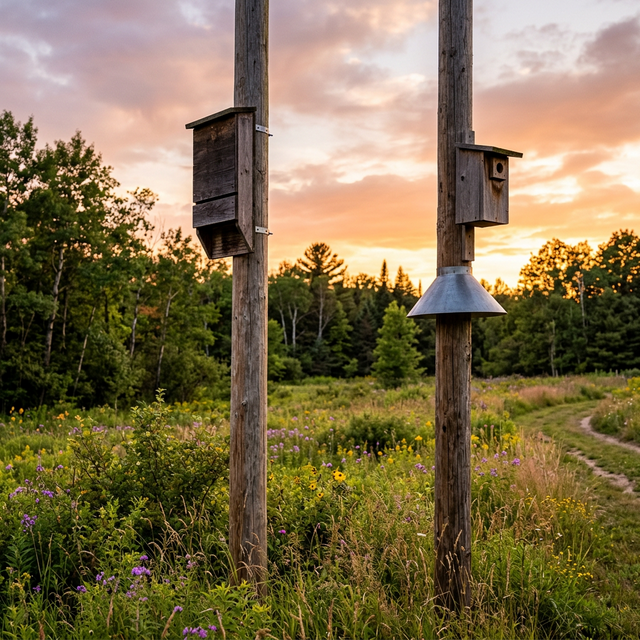
- 10+ Feet from Trees: Never mount a bat box on a tree. Trees create shade, and the branches provide an easy climbing route for owls, snakes, and raccoons waiting to ambush emerging bats. Mount your box on a wooden post, steel pole, or the side of an unshaded barn/house.
2. Bird House Rules: Precision Sizing and Defense
Unlike bats, cavity-nesting birds (like Bluebirds, Chickadees, and Tree Swallows) don't want a hotbox. They want a secure, correctly sized cavity guarded against predators.
The Entrance Hole Dictates the Occupant
You must design the box for the specific bird you want to attract. If the hole is too large, aggressive, non-native house sparrows or European starlings will kill the native birds and steal the box.
- Bluebirds & Tree Swallows: Exactly 1½ inch (1.5") circular hole.
- Chickadees & Wrens: 1â…› or 1ÂĽ inch circular hole.
- Wood Ducks & Screech Owls: 3 x 4 inch oval hole.
Anti-Predator Defenses (Mandatory)
A birdhouse mounted to a fence post without a predator guard is simply a feeding trough for raccoons and rat snakes.
- No Perches: Never buy a birdhouse with a little wooden dowel perch below the hole. Native cavity nesters don’t need it, but predators and invasive sparrows use it to gain access to the hole.
- Baffle the Pole: Always mount bird boxes on smooth metal poles (like conduit) and attach a cone-shaped metal baffle (stovepipe baffle) directly below the box. This physically blocks snakes and raccoons from climbing into the nest.
- Shade and Airflow: Face the entrance hole East, away from prevailing storms and blistering afternoon sun. Ensure drill holes at the top sides for ventilation and bottom corners for drainage.
3. Annual Maintenance & Sanitation
Wildlife boxes are not "set it and forget it" installations. Poor maintenance leads to parasite infestations and disease transmission.
Winter Cleaning Protocol
- Bird Houses: Must be opened and cleaned out every autumn after the nesting season ends. Remove old nests, unhatched eggs, and debris, which harbor highly destructive nest mites. Scrub with a mild 10% bleach solution, rinse thoroughly, and leave open to dry before closing it up for winter.
- Bat Boxes: Inspect in mid-winter using a strong flashlight (when bats have migrated or are hibernating elsewhere). Use a long stick to scrape out abandoned mud dauber or paper wasp nests from the crevices. Wasps are the #1 reason bats abandon a box.
4. Summary and Next Steps
By acting as a responsible landlord, you can attract highly beneficial wildlife to your property, establishing natural pest control and increasing local biodiversity. Success requires strict adherence to sizing, sunlight exposure, and predator baffling.
Action Steps:
- Avoid buying cheap, decorative boxes from big-box stores. Support conservation groups by buying certified boxes (like those approved by Bat Conservation International) or build your own using precise schematics.
- Identify a clearing on your property that receives intense Southern sun for your bat box pole.
- Install your boxes in late winter or early spring (February/March) so they are in place before birds return and bats emerge from hibernation.
For more strategies on integrating wildlife into your land management, read our guide on Managing Edge Habitat and Feral Hog & Coyote Safety.
Sources & Further Reading
- Bat Conservation International (BCI) - Bat House Installation Guide: batcon.org
- NestWatch (Cornell Lab of Ornithology) - Right Bird, Right House Interactive Tool: nestwatch.org
- North American Bluebird Society - Factsheets and Predator Control: nabluebirdsociety.org
- USDA NRCS - Wildlife Habitat Improvement Program: nrcs.usda.gov
Written by Maria Rodriguez, Wildlife Biologist & Conservation Programs Advisor at LandHelp.info. Maria has safely installed hundreds of habitat structures across the U.S. and specializes in non-lethal ecological pest management.
Tags:

Maria Rodriguez
Wildlife Biologist & Conservation Programs Advisor
Maria specializes in wildlife habitat improvement and navigating conservation incentive programs. She has helped hundreds of landowners access NRCS programs and improve habitat on their properties.