Inflation Reduction Act Conservation Dollars: What’s Still Available in 2026?
A practical guide for landowners navigating the remaining $19.5 billion in agricultural conservation funding from the IRA. Learn how to secure EQIP and CSP grants in 2026.
Inflation Reduction Act Conservation Dollars: What’s Still Available in 2026?
When the Inflation Reduction Act (IRA) passed, it injected an unprecedented $19.5 billion directly into the USDA Natural Resources Conservation Service (NRCS). This money was specifically earmarked to help private landowners adopt "climate-smart" agricultural and forestry practices.
Now, in 2026, many of those initial funding pools are beginning to draw down as the 2031 spending deadline approaches. However, due to administrative bottlenecks and the massive scale of the initial appropriation, significant funds are still actively available and waiting to be deployed on small-to-mid-sized rural properties.
Why is this important? Because adopting sustainable practices—like planting multi-row windbreaks, converting cropland to permanent pasture, or installing high-tensile fencing for rotational grazing—is notoriously expensive. If you are paying for these infrastructure upgrades entirely out of pocket in 2026, you are leaving massive amounts of free federal money on the table. Here is your roadmap to accessing the remaining IRA conservation dollars.
1. Where is the Money Actually Going?
The IRA did not create new programs from scratch. Instead, it funneled billions of dollars into existing, proven NRCS frameworks. The two primary engines for landowners are EQIP (Environmental Quality Incentives Program) and CSP (Conservation Stewardship Program).
The "Climate-Smart" Requirement
To qualify for the specific IRA pool of money, your proposed project must explicitly mitigate greenhouse gas emissions or sequester carbon. You cannot use IRA funds simply to build a gravel road or put up a generic boundary fence.
The NRCS maintains a strict list of "Climate-Smart Mitigation Activities." If your project matches one of these codes, it is fast-tracked for funding:
- Practice 340 (Cover Crop): Planting multi-species covers to build soil carbon.
- Practice 528 (Prescribed Grazing): Installing interior fencing and water troughs specifically to facilitate intensive rotational grazing.
- Practice 380 (Windbreak/Shelterbelt Establishment): Planting trees to reduce wind erosion and sequester carbon.
- Practice 666 (Forest Stand Improvement): Thinning overgrown woods to increase carbon storage in the remaining large, healthy timber.
2. Navigating EQIP in 2026 (The Best Starting Point)
If you have never worked with the NRCS, EQIP is your entry point. It is a "cost-share" program designed to fix a specific, acute problem on your land.
How it Works
- The Problem: You have severe gully erosion in a cornfield.
- The Solution: You apply to EQIP (Practice Code 342 - Critical Area Planting) to reshape the gully and plant permanent perennial grasses.
- The Payout: If approved, the NRCS does not hand you cash upfront. Once you successfully complete the project to their strict engineering standards, they reimburse you at a flat, predetermined rate that historically covered 50% to 75% of the total cost.
The 2026 IRA Advantage: Because IRA funds are targeted at historically underserved or "climate-smart" applicants, the cost-share rates for eligible practices often jump to 75% to 90% reimbursement. For beginning farmers or veterans, the NRCS may offer "advance payments," giving you 50% of the cash upfront to buy materials.
3. The Conservation Stewardship Program (CSP)
While EQIP fixes problems, CSP rewards excellence. It is designed for landowners who are already employing excellent conservation practices but want to take their management to the next level.
The Financial Model
CSP involves a strict 5-year contract. You sign an agreement promising to maintain your existing high-level stewardship (like not tilling your soil) while adopting at least one new enhancement every year.
- The Payout: You receive an annual flat payment (often between $1,500 and out to $40,000 per year depending on massive acreage) simply for maintaining the good work you are already doing, plus additional reimbursements for the new enhancements.
- IRA Impact: The IRA drastically increased the minimum annual CSP payment for small agricultural operations, ensuring that even 5- to 10-acre homesteaders receive enough annual funding to make the paperwork worthwhile.
4. How to Actually Apply (Without Losing Your Mind)
The federal government is not famous for its speed or simplicity. Applying for NRCS funding requires patience.
- Establish Farm Records: Before you can even apply, you must walk into your local Farm Service Agency (FSA), which is usually located in the same building as the NRCS. You must register your deed to get a "Farm and Tract Number." You do not need to be a commercial corn farmer to get a farm number; simply owning a woodlot or small pasture qualifies you.
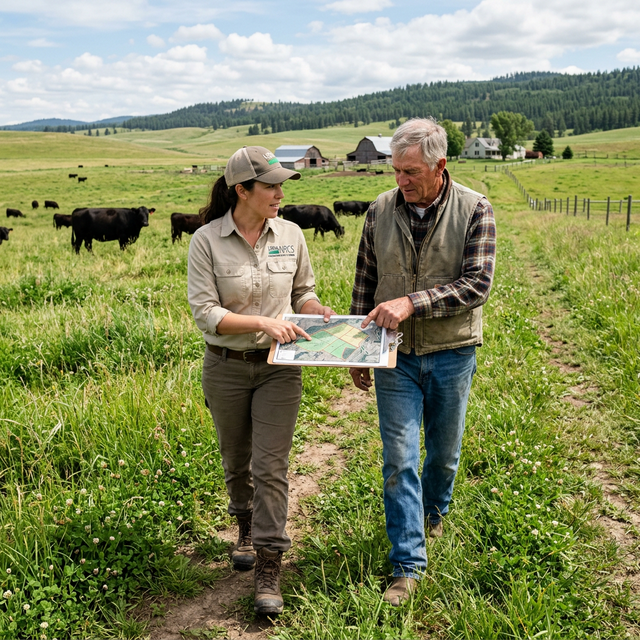
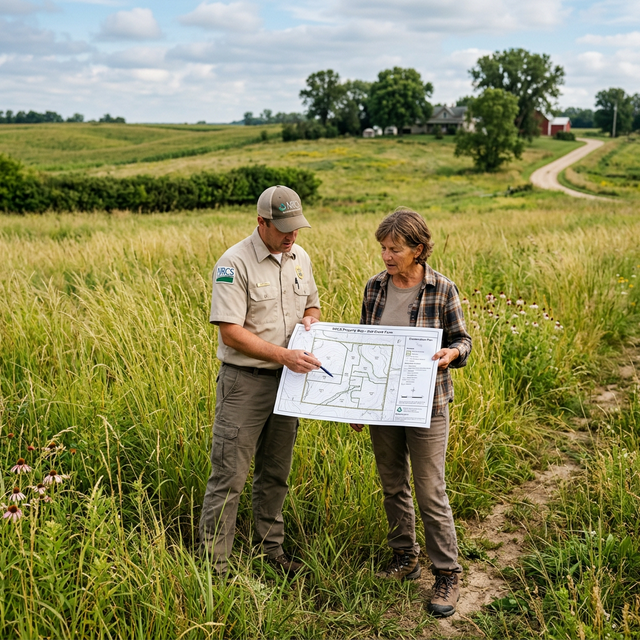
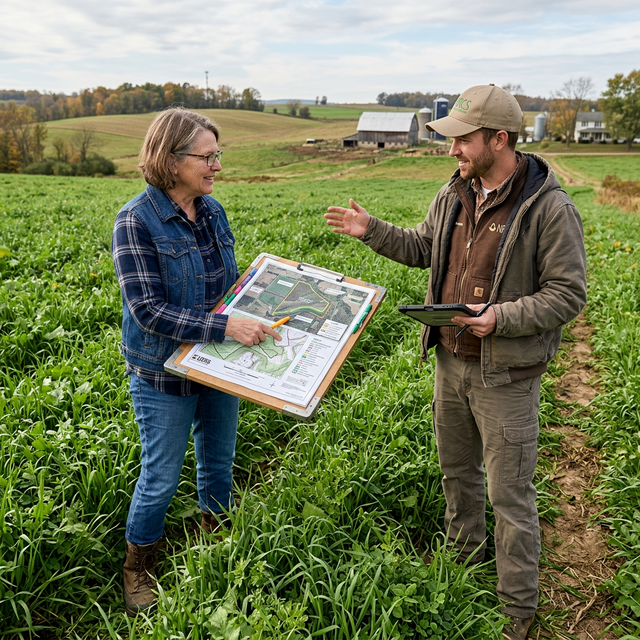
- Schedule a Site Visit: Call your local county NRCS District Conservationist. Ask them to walk your property to discuss your goals. Do not walk in demanding "the IRA money." Walk in asking for help solving a specific erosion or pasture problem. The agent will match your problem to the appropriate funding pool.
- The Waiting Game: EQIP applications are "batched" and ranked against other applications in your state once or twice a year. If you apply in March, you might not secure a contract until November, and you cannot start the physical work until the contract is signed by both parties.
5. Summary and Next Steps
The $19.5 billion IRA injection represents a generational opportunity to fund major infrastructure improvements on private land—from extensive tree planting to advanced rotational grazing systems. By proposing explicitly "climate-smart" practices, you fast-track your application and unlock the highest possible reimbursement rates under EQIP and CSP.
Action Steps:
- Locate your county's USDA Service Center online.
- Gather your property deed and map, and visit the FSA office to establish your Farm and Tract Number.
- Identify one pressing conservation issue on your property (e.g., poor pasture health, eroding creek banks, an overgrown woodlot) and schedule a site visit with an NRCS agent to discuss solutions.
For specific project ideas that rank highly for funding, explore our guides on Planting Windbreaks and Frost Seeding Legumes.
Sources & Further Reading
- USDA NRCS - Inflation Reduction Act Conservation Funding Fact Sheet: nrcs.usda.gov
- National Sustainable Agriculture Coalition (NSAC) - A Farmer's Guide to the IRA: sustainableagriculture.net
- USDA Farm Service Agency (FSA) - How to Start a Farm Record: fsa.usda.gov
- Rural Advancement Foundation International (RAFI-USA) - Navigating USDA Programs: rafiusa.org
Written by Maria Rodriguez, Wildlife Biologist & Conservation Programs Advisor at LandHelp.info. Maria spent six years as an NRCS field agent and now exclusively helps private landowners navigate the complexities of federal conservation contracts.
Tags:
Maria Rodriguez
Wildlife Biologist & Conservation Programs Advisor
Maria specializes in wildlife habitat improvement and navigating conservation incentive programs. She has helped hundreds of landowners access NRCS programs and improve habitat on their properties.