Planting Windbreaks and Shelterbelts in 2026: Updated Species Recommendations
Protect your property, livestock, and crops with modern windbreak designs. Learn the most resilient tree species to plant for shelterbelts in 2026.
Planting Windbreaks and Shelterbelts in 2026: Updated Species Recommendations
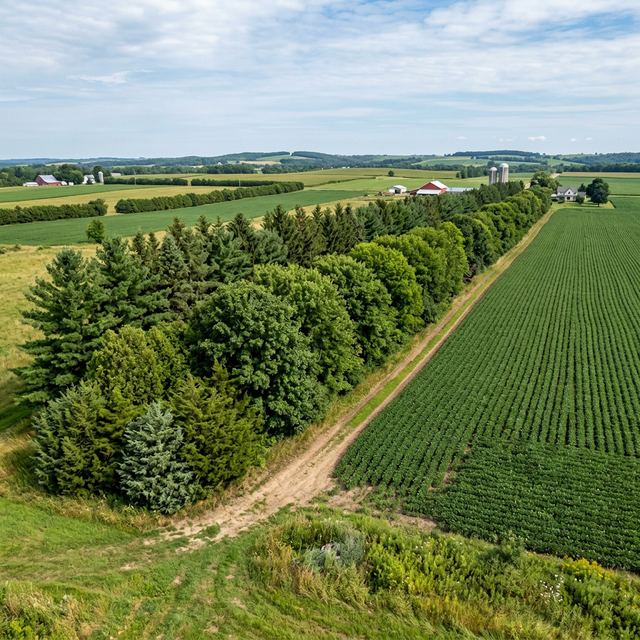
The concept of planting rows of trees to block the wind isn't new; it dates back to the massive shelterbelt programs of the Dust Bowl era. However, the reality of planting windbreaks in 2026 is vastly different. With changing hardiness zones, unpredictable precipitation patterns, and new pest pressures, the exact species your grandfather planted 40 years ago likely won't survive today.
A well-designed windbreak (or shelterbelt) is one of the highest-ROI investments a landowner can make. They reduce home heating costs by up to 30%, protect topsoil from wind erosion, increase crop yields by mitigating heat stress, and provide critical winter shelter for livestock.
Why is updating your species list so vital right now? Because planting a monoculture (a single species) of trees that isn't adapted to today's climate guarantees catastrophic failure if a drought or new insect arrives. In this guide, we'll break down how to design a modern, resilient windbreak and exactly what species you should be planting in 2026.
1. The Anatomy of a Modern Windbreak
A windbreak is not just a straight line of evergreens. To be effective, it must be permeable, allowing some wind to pass through while forcing the majority up and over the protected area. A solid "wall" of trees actually creates damaging turbulence on the downwind side.
The Multi-Row Approach
The USDA Natural Resources Conservation Service (NRCS) highly recommends a minimum of three rows for farmstead and livestock protection:
- The Windward Row (Outside edge facing the wind): Dense, fast-growing shrubs to catch blowing snow and slow ground-level wind.
- The Center Row(s): Tall, long-lived deciduous trees (or tall conifers) that provide the primary height, pushing the wind up.
- The Leeward Row (Inside edge facing the property): Evergreen trees that maintain year-round foliage density, especially crucial in winter.
Spacing and Permeability
Aim for 40% to 60% density during the winter months. If looking straight at the windbreak, you should be able to see small patches of sky through the branches. Trees should be spaced far enough apart that their mature crowns just barely touch. Overcrowding leads to lower limb die-off, defeating the purpose of a ground-level wind barrier.
2. Updated Species Recommendations for 2026
When selecting species, diversity is your only defense against complete windbreak failure. Never plant more than 20% of your windbreak to a single species or family.
Note: The species below are generalized for the Midwest and Great Plains. Always consult your local extension office for site-specific recommendations based on your soil type.
What to STOP Planting in 2026
- Ash (Fraxinus spp.): Emerald Ash Borer has effectively eliminated ash as a viable planting option in North America.
- Colorado Blue Spruce (Picea pungens): Outside of their native high-altitude range, they are highly susceptible to Cytospora canker and Rhizosphaera needle cast in humid, warming climates.
- Austrian Pine (Pinus nigra): Devastated by Diplodia (Sphaeropsis) tip blight.
- Siberian Elm (Ulmus pumila): Often becomes invasive, is brittle, and breaks easily in ice storms.
Top Recommendations: The Windward Row (Shrubs)
These shrubs can handle the brunt of the wind and trap drifting snow before it reaches the taller trees.
- American Plum (Prunus americana): Tough, suckering native that produces edible fruit and excellent wildlife habitat.
- Redosier Dogwood (Cornus sericea): Excellent for wet or poorly drained soils; provides striking red winter color.
- Common Lilac (Syringa vulgaris): A legacy shrub that remains highly drought-hardy and provides dense lower foliage.
- Chokecherry (Prunus virginiana): Fast-growing and resilient, though highly toxic to horses and cattle if wilted foliage is ingested (plant outside livestock areas).
Top Recommendations: The Center Row (Tall Deciduous)
These trees provide the "lift" needed to push wind over your structures.
- Bur Oak (Quercus macrocarpa): Slow to start, but incredibly drought-tolerant, wind-firm, and unbothered by most pests. A 200-year investment.
- Hackberry (Celtis occidentalis): A tough, adaptable native that handles drought and wind exceptionally well once established.
- Kentucky Coffeetree (Gymnocladus dioicus): Structurally strong, no major pest issues, and highly tolerant of poor soils.
- Hybrid Poplar (Populus spp.): Use only as a temporary "nurse" tree for fast height; they are short-lived (15-20 years) and should be interplanted with slower, permanent species.
Top Recommendations: The Leeward Row (Evergreens)
These provide the crucial winter density when deciduous trees have lost their leaves.
- Eastern Redcedar (Juniperus virginiana): Arguably the toughest native evergreen available. It survives extreme heat and drought. Warning: Do not plant near apple orchards due to cedar-apple rust.
- White Fir (Abies concolor): A much healthier, disease-resistant alternative to the ailing Colorado Blue Spruce for providing dense, blue-green foliage.
- Norway Spruce (Picea abies): Fast-growing and currently handling changing climates better than many native spruces, though it prefers slightly moist soils.
- Ponderosa Pine (Pinus ponderosa): Excellent for drier, well-drained upland sites in the West and Plains.
3. Site Preparation and Planting Success
You cannot simply stick a bare-root seedling in a grassy field and expect it to survive a drought summer.
Weed Control is Mandatory
Grass is the enemy of tree seedlings. Turfgrass and pasture grasses will out-compete young trees for every drop of moisture.
- You must maintain a 3- to 4-foot vegetation-free zone around every tree for the first 3 to 5 years.
- Use heavy, woven landscape fabric (with a woodchip mulch over top) or rigorous mechanical/chemical weed control.
Watering and Protection
- Irrigation: If you cannot run drip tape, you must have a water wagon to deliver 5-10 gallons per tree every 7-10 days during dry spells for the first two years.
- Animal Damage: Deer and rabbits kill more windbreaks than drought. Use 4-foot vexar tubes or woven wire cages for deciduous trees immediately upon planting.
4. Funding Your Windbreak
Windbreaks are expensive to establish, but you don't have to shoulder the entire cost. The USDA NRCS Environmental Quality Incentives Program (EQIP) offers substantial cost-share assistance for establishing windbreaks (Practice Code 380).
If your windbreak is designed to protect livestock, reduce soil erosion, or improve water quality, you are highly likely to qualify for funding. Check out our Conservation Programs & Funding section for step-by-step guides on applying.
5. Summary and Next Steps
Planting a windbreak in 2026 requires abandoning old monoculture habits and embracing species diversity. Focus on resilient natives like Bur Oak and Eastern Redcedar, enforce strict weed control for the first three years, and utilize NRCS funding to offset costs.
Ready to start?
- Map your prevailing winter wind direction (usually Northwest in North America).
- Measure the distance you need to protect (a windbreak protects an area downwind equal to 10-15 times its height).
- Contact your local NRCS or county extension forester to schedule a site visit and select appropriate species.
For more resources on managing forests and planting trees, explore our Forests & Woodlands category.
Sources & Further Reading
- USDA National Agroforestry Center - Windbreak Design and Guidelines: fs.usda.gov
- University of Nebraska�Lincoln Extension - Windbreak Establishment and Maintenance: extension.unl.edu
- Penn State Extension - Trees and Shrubs for Windbreaks: extension.psu.edu
- USDA NRCS - EQIP Practice Code 380 (Windbreak/Shelterbelt Establishment): nrcs.usda.gov
Written by Dr. Sarah Mitchell, Senior Editor & Land Management Specialist at LandHelp.info. Dr. Mitchell holds a Ph.D. in Natural Resource Management and has spent over 20 years designing resilient agroforestry systems for private landowners across the Midwest.
Tags:
Dr. Sarah Mitchell
Senior Editor & Land Management Specialist
Dr. Mitchell has over 20 years of experience in natural resource management, with expertise in sustainable agriculture and forest stewardship. She holds a Ph.D. in Natural Resource Management from Colorado State University and has worked with the USDA NRCS for 15 years.