Creating a Firewise Community Around Your Property: What Neighbors Should Do Together
Wildfire does not respect property lines. Learn how to rally your rural neighbors to create a defensible, Firewise community against catastrophic wildfires in 2026.
Creating a Firewise Community Around Your Property: What Neighbors Should Do Together
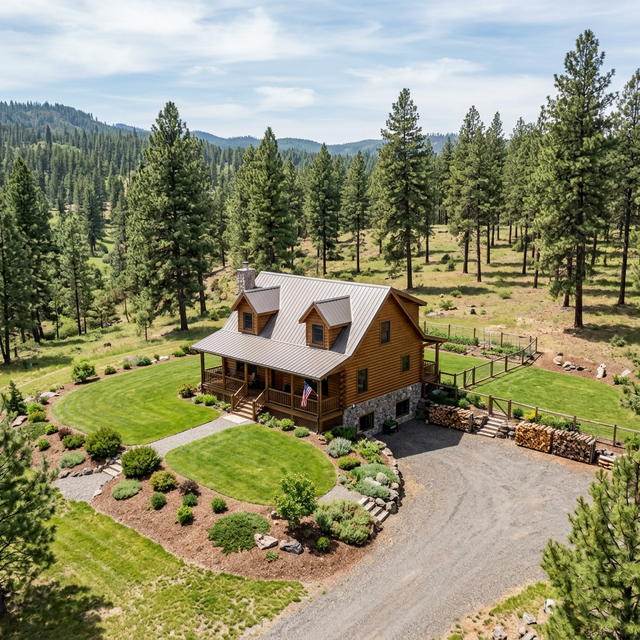
If you own 10, 50, or 100 acres in the wildland-urban interface (WUI), you have likely spent considerable time and money creating "defensible space" around your primary residence. You installed a metal roof, cleared the brush 100 feet back, and limbed up your pine trees. Your home is a fortress.
But what about your neighbor's property?
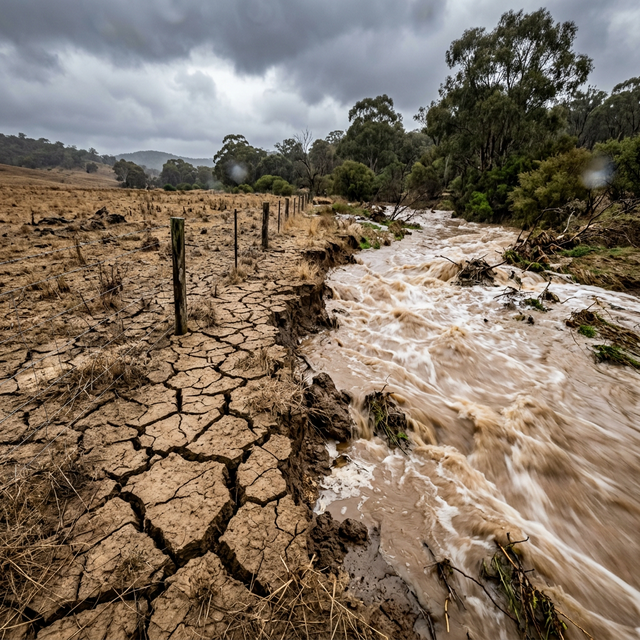
If the 40 acres immediately adjacent to your fence line belong to an absentee landowner who allows heavy, dry brush to accumulate under a dense, dead canopy of pine beetles, your fortress is in grave danger. Wildfire does not respect property lines. In the extreme drought and high-wind conditions characteristic of modern fire seasons in 2026, a massive crown fire next door will generate a blizzard of "fire embers"—raining burning debris onto your property from miles away.
To truly protect your land, you cannot operate in isolation. You must shift from individual defense to community-based resilience by becoming a recognized "Firewise Community." This guide explains exactly how to organize your neighbors and execute landscape-scale fire defense.
1. What is the Firewise USA® Program?
Firewise USA® is a national framework created by the National Fire Protection Association (NFPA) to help neighbors work together to reduce wildfire risks. Becoming officially recognized is not just an honorary plaque; it provides tremendous financial leverage.
The Financial Incentives
Why should your neighbors care? Because of insurance. Across the Western United States and increasingly in the Southeast, homeowners are seeing their property insurance policies canceled entirely due to wildfire risk. Many major insurance carriers (like USAA and State Farm) now offer explicit policy discounts—or will agree to underwrite policies that would otherwise be denied—if the property is located within an officially recognized Firewise USA site.
Furthermore, state forestry departments often prioritize grant funding for massive mechanical brush-clearing projects to communities that have formal Firewise organizations in place.
2. Organizing the Initial Effort
You cannot march onto your neighbor's property with a chainsaw. You must build consensus.
Step 1: Form a Board and Define the Boundaries
Start small. Identify 8 to 15 contiguous households sharing a common geographical feature—perhaps everyone living along a single 3-mile gravel road, or occupying a specific canyon. Host an informal backyard barbecue or community hall meeting to discuss the shared risk and the insurance benefits of working together.
Step 2: The Professional Risk Assessment
Contact your local county fire marshal, state forestry agency, or local conservation district. They will send a fire professional to walk the community boundaries and write a formal "Community Wildfire Risk Assessment." They will point out specific, shared vulnerabilities, such as a single, brush-choked exit road that would trap everyone during an evacuation.
Step 3: Write the Action Plan
Based on the assessment, the board creates a multi-year action plan. This is not a legal mandate; participation is voluntary. The plan outlines specific mitigation goals the community hopes to achieve.
3. Top Priority Community-Led Projects
When neighbors pool resources (money, heavy equipment, and labor), they can tackle projects that a single landowner could never afford. Here are the most effective shared projects in 2026:
1. Hardening the Evacuation Route
If everyone shares a single access road, it must be cleared. If a wildfire strikes, residents are trying to drive out while massive fire engines are trying to drive in.
- The Project: Pool funds to rent a large "forestry mulcher" (a tracked skid-steer with a grinding head) for a weekend. Run it down both sides of the main access road, clearing a 30-foot buffer of brush and low branches on either side. This prevents the road from becoming a tunnel of fire, ensuring safe passage and rapid fire department response.
2. Community Chipping Days
The hardest part of clearing brush around a home is disposing of the massive piles of slash. Burning it is often hazardous or legally prohibited during fire season.
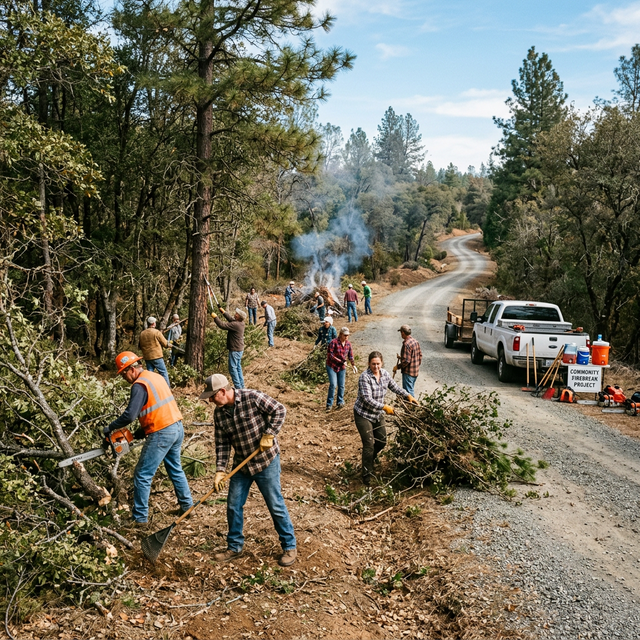
- The Project: The Firewise board organizes a "Community Chipping Day." Neighbors drag all their cut brush to the end of their driveways. The community uses grant money or pools dues to hire a commercial tree service with an industrial woodchipper to drive down the road, chipping everyone's piles in a single day.
3. Sharing Heavy Equipment and Water Infrastructure
- Does one neighbor own an excavator or a massive tractor? Trade them diesel fuel and manual labor on their property in exchange for using their machine to dig a defensive firebreak along the prevailing wind line of the community.
- If a landowner has a large, deep agricultural pond, the community can chip in to install a "dry hydrant" (a permanent PVC pipe extending into the pond with a fire hose connection on the bank). This allows rural fire departments to draft thousands of gallons of water instantly without driving a tanker truck 10 miles back to municipal water.
4. Addressing the "Absentee Landowner" Problem
Invariably, you will have a neighbor who rarely visits their land and refuses to clear their brush.
- First, approach them gently with the financial reality: an overgrown property is an enormous liability. Suggest that if they pay for the diesel, the community will bring chainsaws and clear their fence line for free to protect the neighborhood.
- If they refuse, you must double your defensible space efforts internally. Create a "shaded fuel break" intensely along your shared property line to ensure their inevitable fire drops out of the tree canopy before crossing onto your land.
5. Summary and Next Steps
The reality of 2026 is that individual defensible space alone will not stop a mega-fire. By organizing your rural neighborhood into a Firewise Community, you unlock insurance discounts, state grant funding, and the heavy machinery required to harden your landscape at scale.
Action Steps:
- Visit the Firewise USA website and read the brief requirements for starting a local chapter.
- Form a list of 5 to 10 immediate neighbors who share your access road or geographical ridge.
- Call your local fire department or state forestry office to schedule a free communal wildfire risk assessment.
Be sure to complement your physical preparations with technological awareness by exploring our 2026 guide on Smartphone Apps and Free Tools for Real-Time Wildfire Monitoring.
Sources & Further Reading
- National Fire Protection Association (NFPA) - Firewise USA® Program Overview: nfpa.org/firewise
- U.S. Forest Service - Community Wildfire Defense Grants: fs.usda.gov
- Insurance Institute for Business & Home Safety (IBHS) - Wildfire Ready Resources: ibhs.org
- Coalitions & Collaboratives (COCO) - Action Guides for Wildfire Mitigation: co-co.org
Written by Prof. James Chen, Contributing Expert - Water Resources and Wildfire Mitigation at LandHelp.info. Professor Chen consults with rural municipalities across the West on landscape-scale emergency preparedness and drought resilience.
Tags:

Prof. James Chen
Contributing Expert - Water Resources
Professor Chen is a leading expert in watershed management and water conservation. With 25 years in academic research and extension, he has published extensively on sustainable water management practices for agricultural lands.