Creating Defensible Space Around Your Home – Wildfire Preparation Checklist
A step-by-step checklist for creating defensible space around your rural home. Learn how to manage the three zones of wildfire defense to protect your property and family.
Creating Defensible Space Around Your Home – Wildfire Preparation Checklist
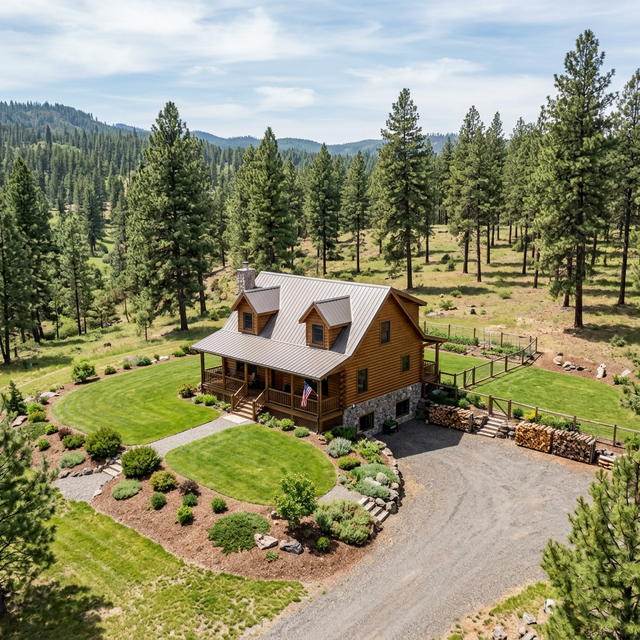
If you live in a rural or wildland-urban interface (WUI) area, the question is not if a wildfire will occur near your property, but when.
During a major fast-moving wildfire, firefighting resources are stretched thin. You cannot count on a fire truck parking in your driveway to save your home. Your home must be able to stand alone and survive on its own.
The concept of "defensible space" is the buffer you create between a building on your property and the grass, trees, shrubs, or any wildland area that surrounds it. This space is needed to slow or stop the spread of wildfire and protects your home from catching fire—either from direct flame contact or radiant heat.
Creating defensible space doesn't mean clear-cutting your property. It means strategic management of the Home Ignition Zone. Here is your step-by-step checklist.
The Three Zones of Defensible Space
The Home Ignition Zone is divided into three critical areas. You must start at the house and work your way out.
Zone 0: The Immediate Zone (0 to 5 feet from the structure)
Goal: Prevent embers from accumulating and igniting the house.
In a wildfire, flying embers (firebrands)—not the terrifying wall of flames—destroy up to 90% of homes. Embers can travel more than a mile ahead of the main fire, landing in gutters, under decks, and in foundation mulch, smoldering until they ignite the structure.
Zone 0 Checklist:
- Remove all flammable vegetation within 5 feet of the house. No foundation shrubs, no tall ornamental grasses, no climbing vines.
- Replace organic wood mulch with gravel, crushed rock, or bare dirt within 5 feet of the foundation.
- Clean gutters and roofs of all pine needles, leaves, and debris—check this weekly during fire season.
- Install 1/8-inch metal mesh screening over all exterior vents (attic, soffit, and foundation) to prevent embers from blowing inside.
- Never store firewood or lumber against the house or under a deck. Move it at least 30 feet away.
- Enclose the space under wooden decks with fire-resistant skirting or 1/8-inch wire mesh.
- Remove combustible patio furniture or doormats when a Red Flag Warning is issued.
Zone 1: The Intermediate Zone (5 to 30 feet from the structure)
Goal: Prevent fire from spreading through the canopy and reaching the house.
This area should be lean, clean, and green. Landscaping here should be sparse, well-irrigated, and low to the ground.
Zone 1 Checklist:
- Keep grass mowed to a maximum height of 4 inches.
- Ensure trees are spaced so that their mature canopies are at least 10 to 18 feet apart.
- Remove "ladder fuels" (vegetation that allows a fire burning in the grass to climb up into tree canopies). Prune lower tree branches up to 6–10 feet from the ground (but don't remove more than 1/3 of the tree's total height).
- Remove completely any highly flammable evergreen trees or shrubs (like junipers, cedars, or arborvitae) from this zone. They are affectionately known by firefighters as "green gas cans."
- Create separation between low-level shrubs and tree branches. The clearance space should be 3 times the height of the shrub.
- Install hardscaping (driveways, stone patios, gravel paths) to break up continuous fuel beds.
Zone 2: The Extended Zone (30 to 100 feet from the structure)
Goal: Slow the speed and decrease the intensity of an approaching wildfire.
You do not need to eliminate vegetation here, but you must aggressively manage its density. This zone provides the crucial buffer that forces a high-intensity "crown fire" (burning in the tops of trees) to drop to the ground, where it is much easier to control.
Zone 2 Checklist:
- Thin the forest canopy. For flat ground, leave 12 feet between individual tree canopies. Note: If your property is on a steep slope, this distance must increase. Fire moves much faster uphill.
- Remove dead trees (snags) and heavy accumulations of dead fallen branches.
- Continue to eliminate ladder fuels by pruning lower branches.
- If you have a large property, consider establishing a prescribed burn program in the outer woodlands to consume leaf litter and brush safely during the wet season.
- Ensure your driveway is at least 12 feet wide with 15 feet of vertical clearance so large fire engines can safely access and turn around on your property.
Note for steep slopes: If your home is situated on a steep hill, Zone 2 should extend out to 150 or 200 feet downhill from the house, as fire pre-heats the fuels above it and rushes uphill.
Fire-Resistant Home Upgrades
While clearing vegetation is critical, "hardening" the home itself is the second half of the equation. If you are building, remodeling, or simply replacing worn-out materials, prioritize these upgrades:
- Class A Rated Roof: The roof is the most vulnerable part of your house. Asphalt composition shingles, metal, tile, and slate are Class A fire-rated. Never use wood shake shingles in a wildfire-prone area.
- Double-Pane Tempered Glass Windows: Radiant heat from a fire can shatter standard single-pane windows from 100 feet away, allowing flames inside. Dual-pane tempered glass is far more resilient.
- Non-Combustible Siding: Stucco, fiber-cement (like HardiePlank), brick, or stone are highly recommended over vinyl (which melts) or untreated wood (which ignites).
Community Action and Grants
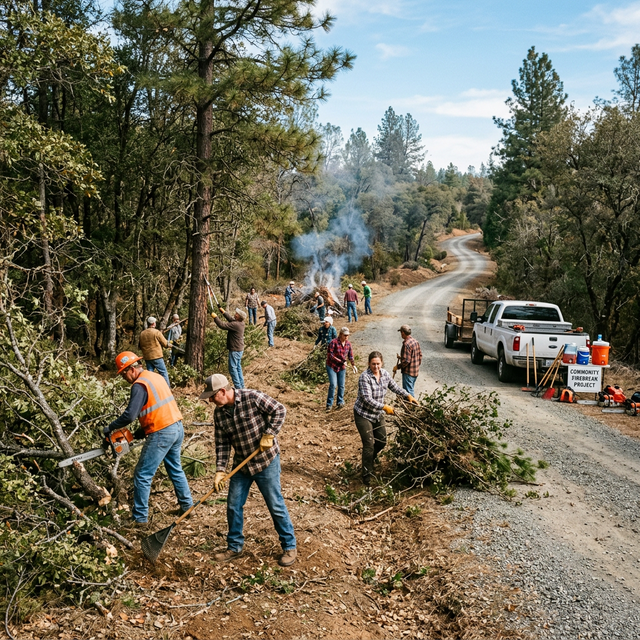
Wildfire does not respect property lines. If you perfectly maintain your defensible space, but your neighbor's property is an overgrown thicket of dead pine trees touching your fence, your home is still at risk.
The Firewise USA® Program Encourage your neighbors to join you in becoming a recognized Firewise USA community. The program provides a framework to help neighbors work together in a geographic area to reduce wildfire risk.
Many state forestry agencies and the USDA Forest Service offer fuels reduction grants or cost-share programs to help private landowners pay for the expensive work of thinning large trees and masticating (grinding) brush in Zone 2. Contact your local fire department or state forestry office to inquire about "Hazardous Fuels Reduction Grants."
Summary
Creating defensible space is the single most important action you can take to ensure your rural home survives a wildfire. Start at the house (Zone 0) and ruthlessly eliminate all combustible materials within 5 feet. Work your way outward, thinning trees, removing ladder fuels, and keeping grass mowed. It takes a weekend of hard work with a chainsaw, a rake, and a weed-whacker to vastly improve your odds of survival.
Explore more: Learn how to safely use Prescribed Burning to manage fuels on larger acreages, or review our guide to Emergency Planning for Floods and Drought.
Sources & Further Reading
- National Fire Protection Association (NFPA) — Firewise USA: nfpa.org/firewise
- CAL FIRE — Prepare for Wildfire (Defensible Space): readyforwildfire.org
- Insurance Institute for Business & Home Safety (IBHS) — Wildfire Ready: disastersafety.org
- US Forest Service — Wildland Urban Interface: fs.usda.gov
- Colorado State Forest Service — Home Ignition Zone Guide: csfs.colostate.edu
Written by Dr. Sarah Mitchell, Senior Editor & Land Management Specialist at LandHelp.info. Dr. Mitchell has extensive experience in post-wildfire ecological recovery and works with landowners to implement Firewise landscaping practices in the Wildland-Urban Interface.
Tags:

Dr. Sarah Mitchell
Senior Editor & Land Management Specialist
Dr. Mitchell has over 20 years of experience in natural resource management, with expertise in sustainable agriculture and forest stewardship. She holds a Ph.D. in Natural Resource Management from Colorado State University and has worked with the USDA NRCS for 15 years.