How to Create a Simple 5-Year Land Management Plan for Your Property
Learn how to build a practical, step-by-step 5-year land management plan for your private property. Includes templates, tips from USDA NRCS, and guidance for small landowners.
How to Create a Simple 5-Year Land Management Plan for Your Property
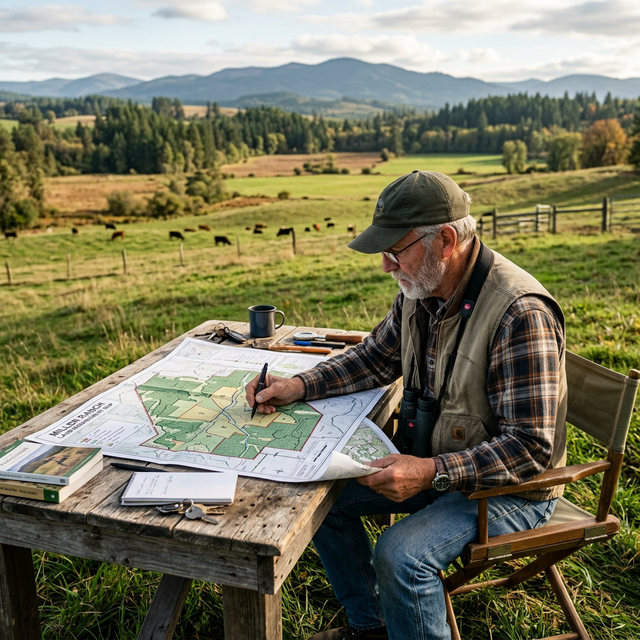
Most landowners know they should have a management plan — but very few actually have one written down. Without a clear plan, it's easy to spend money on reactive fixes (erosion after a flood, invasive species that got out of hand) instead of proactive improvements that build long-term value.
The good news: you don't need to hire a consultant or spend thousands of dollars to create a solid 5-year land management plan. This guide walks you through the entire process — from setting goals to mapping resources — in a practical, step-by-step format based on frameworks used by USDA NRCS and university extension services.
Why a 5-Year Plan? The Sweet Spot for Private Lands
A 5-year timeframe hits the sweet spot for most private landowners:
- Long enough to see real ecological and economic results (planted trees establish, pastures recover, ponds fill)
- Short enough to stay realistic and adaptable to weather, finances, and family changes
- Aligned with USDA programs — EQIP and CSP contracts often run 5 years
A 1-year plan is too short to track meaningful progress. A 10-year plan tends to collect dust because it feels too abstract.
Step 1: Define Your Goals (What Do You Want from This Land?)
Before touching a shovel or signing up for any program, answer these three questions:
- What do you value most about this property? (Wildlife habitat, timber income, a place to hunt, pasture for cattle, privacy)
- What problems are you trying to solve? (Erosion, invasive species, poor pasture, flooding)
- What does success look like in 5 years? (Specific, measurable outcomes)
Example Goal Statement
"By 2031, I want to: (1) establish 10 acres of native pollinator habitat along the creek, (2) reduce erosion on the east slope by 80%, and (3) have a productive food plot that supports a healthy deer population for sustainable hunting."
Write your goals down. According to research from Dominican University, people who write their goals are 42% more likely to achieve them.
Step 2: Take a Resource Inventory (Know What You Have)
Walk your land systematically and document:
| Resource | What to Document |
|---|---|
| Soils | Soil types (use Web Soil Survey at websoilsurvey.usda.gov), drainage, compaction |
| Vegetation | Existing trees, grasses, invasive species presence |
| Water | Ponds, streams, wetlands, drainage patterns, erosion areas |
| Wildlife | Signs of deer, turkey, songbirds, pollinators |
| Infrastructure | Fences, roads, buildings, irrigation systems |
| Boundaries | Legal property boundaries confirmed |
Pro tip: Use the USDA's free Web Soil Survey to get detailed soil maps of your property without hiring a soil scientist.
Step 3: Map Your Property
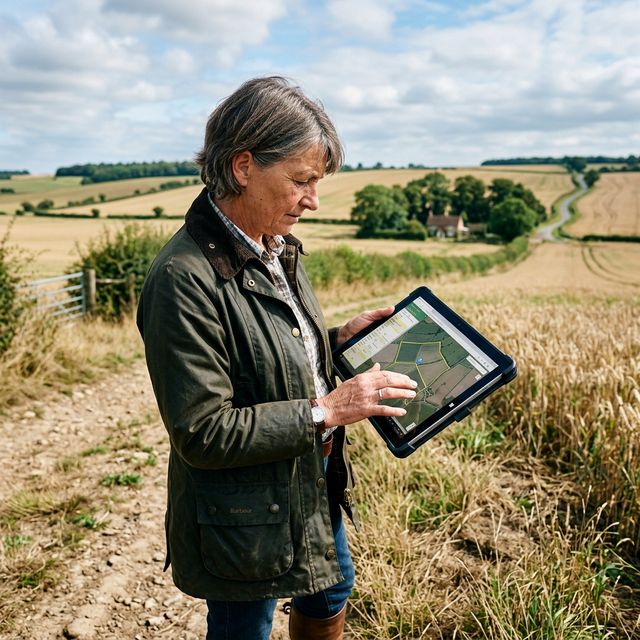
A simple property map is one of the most useful tools you can create. You don't need expensive GIS software — here are free options:
Free Mapping Tools for Landowners
- Google My Maps — draw polygons, add notes, share with family
- CalTopo — excellent for topography and land measurement
- QGIS — powerful open-source GIS for more advanced mapping
- OnX Maps — mobile-friendly, great for landowners who prefer an app
At minimum, your map should show:
- Property boundaries
- Major vegetation zones (forest, pasture, wetland)
- Water features
- Existing infrastructure
- Problem areas (erosion, invasive species hotspots)
➡️ See our guide: Property Mapping Tools: Free and Low-Cost Options for Private Landowners
Step 4: Prioritize Your Practices (Year by Year)
Once you know your goals and resources, build a year-by-year action schedule. Use this simple framework:
Year 1: Foundation Work
Focus on soil testing, invasive species assessment, fencing if needed, and any emergency fixes (severe erosion, drainage problems). This is also the year to apply for USDA NRCS programs — EQIP applications are accepted year-round, and cost-share payments can fund 50–90% of practice costs.
Year 2: Habitat and Water Improvements
Plant native trees or grasses, establish cover crops, install wildlife watering structures, add riparian buffers along streams.
Year 3: Monitoring and Adjustment
Assess Year 1 and 2 practices. Are the cover crops working? Has the erosion slowed? Adjust your approach based on real results.
Year 4: Expand and Diversify
Scale up what's working. Add new enterprises (a hunting lease, agritourism trail, timber thinning).
Year 5: Review and Renew
Evaluate progress against your original goals. Write your next 5-year plan — you'll be surprised how much easier it is with 5 years of experience.
Step 5: Budget Your Plan
Even a modest land management plan needs a budget. Break it down into:
- One-time costs: Tree planting, pond construction, fencing, invasive species treatment
- Annual costs: Mowing, herbicide, monitoring, soil testing
- Potential income: Timber sales, hunting lease revenue, carbon credits, USDA cost-share payments
Example budget for a 50-acre mixed woodland/pasture property:
| Practice | Estimated Cost | Potential Funding |
|---|---|---|
| Soil testing (5 sites) | $150 | N/A |
| Invasive species treatment | $800/year | EQIP (50% cost-share) |
| Native tree planting (2 acres) | $1,200 | EQIP (75% cost-share) |
| Prescribed burn (15 acres) | $900 | CSP payment |
| Wildlife water development | $400 | EQIP (50% cost-share) |
Step 6: Write It Down — Your Plan Template
A functional land management plan doesn't need to be a 50-page document. A good working plan includes:
- Property description (acres, location, legal description)
- Resource inventory summary
- Goals (3–5 clear, measurable goals)
- Year-by-year practice schedule
- Budget
- Monitoring log (annual check-ins)
➡️ Download our free template: Land Management Plan Template
Working with USDA NRCS
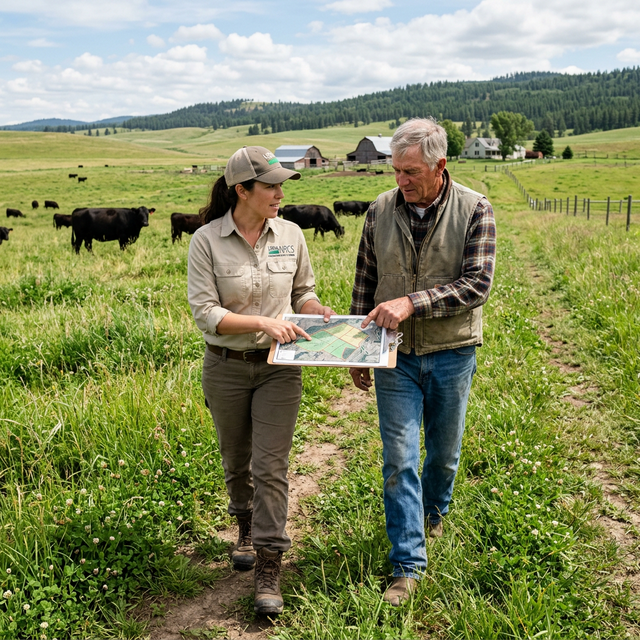
Your local USDA NRCS office offers free technical assistance for private landowners. A conservation planner can help you:
- Conduct resource inventories
- Write a formal conservation plan
- Identify funding opportunities (EQIP, CSP, RCPP)
- Connect with local technical service providers
According to USDA NRCS, conservation plans developed with technical assistance are more likely to achieve their conservation goals and remain in place long-term. Find your local office at nrcs.usda.gov.
Common Mistakes to Avoid
- Skipping the inventory: You can't improve what you don't measure.
- Setting too many goals: Pick 3–5 priorities. More than that, and nothing gets done.
- Ignoring the budget: Every practice has a cost. Know your numbers before you start.
- Never reviewing: A plan that isn't updated every 1–2 years quickly becomes irrelevant.
- Going it alone: Use your local extension service, NRCS, and state forestry agency — they exist to help you.
Summary
A 5-year land management plan doesn't need to be complicated. Start with clear goals, document what you have, map your resources, and build a realistic year-by-year schedule. Use free USDA NRCS resources and your local extension office for support.
Ready to take the next step? Browse our Planning & Land Management resources for tools, templates, and expert guides — or check out our free soil testing guide to kick off your resource inventory.
Sources & Further Reading
- USDA Natural Resources Conservation Service — Conservation Planning: nrcs.usda.gov/conservation-basics/conservation-planning
- Iowa State University Extension — Farm Succession Planning: extension.iastate.edu
- USDA Web Soil Survey: websoilsurvey.usda.gov
- Extension Foundation — Whole Farm Planning: extension.org
- Savory Institute — Holistic Management Framework: savory.global
- Dominican University Study on Goal Setting: scholar.dominican.edu
- USDA NRCS EQIP Program: nrcs.usda.gov/programs-initiatives/eqip
Written by Dr. Sarah Mitchell, Senior Editor & Land Management Specialist at LandHelp.info. Dr. Mitchell holds a Ph.D. in Natural Resource Management from Colorado State University and has over 20 years of experience working with private landowners and the USDA NRCS.
Tags:
Dr. Sarah Mitchell
Senior Editor & Land Management Specialist
Dr. Mitchell has over 20 years of experience in natural resource management, with expertise in sustainable agriculture and forest stewardship. She holds a Ph.D. in Natural Resource Management from Colorado State University and has worked with the USDA NRCS for 15 years.
You Might Also Like
Related Resources
External tools, guides, and references related to this topic
Holistic Management: A New Framework for Decision Making
Allan Savory's seminal book on holistic management - the framework that helps land managers make decisions that are economically, environmentally, and socially sound. Essential reading for anyone managing grazing lands.
NRCS Conservation Planning
The USDA Natural Resources Conservation Service provides comprehensive guidelines for developing conservation plans. Includes worksheets, templates, and step-by-step planning processes.
Property Mapping with GIS
Learn how to create detailed property maps using free GIS tools like QGIS. Covers boundary mapping, resource inventory mapping, and creating management zones.
Land Succession Planning Guide
A practical guide for farm and ranch families on succession planning. Covers estate planning, transferring management to the next generation, and maintaining land in the family.